

Explanation of the Lord's Prayer
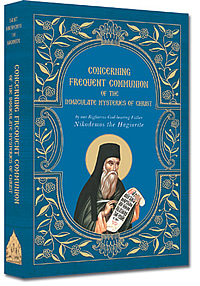
An Excerpt from Concerning Frequent Communion
by St. Nikodemos the Hagiorite
Webmaster Note: This book should be read by all pious Orthodox Christians. It is not a "book only for clergy." Rather it is one that contains rich Patristic content, written for all the Faithful, and in a way that moves the heart deeply. It will help you draw closer to God by instructing you in the two-fold action of regular ascetic struggle and reception of the Holy Mysteries. This book teaches clearly and convincingly that much Grace is given to those who frequently and worthily partake of Holy Communion. In reading this book you will gain a new appreciation for Holy Communion; will increase your efforts to watch over yourself more carefully; and will endeavor to partake whenever possible.
Chapter 5: Give us this day our superessential bread
...Third, the superessential bread is the body and blood of the Lord, which differs as much from the word of God as does the sun from a ray. In divine Communion, the Sun that is the whole God-man enters into, mixes with, and leavens the whole man, being He Who illumines, enlightens, and sanctifies all of the powers and senses of the soul and body of man, and refashions him from corruption to incorruption. [46]
Thus the words “superessential bread” primarily and for an especial reason refer to the divine Communion of the all-immaculate body and blood of our Lord Jesus Christ, for it preserves and sustains the essence of the soul, and gives it the strength to do the Master’s commandments and everything else, as our Lord says: “For My flesh is meat indeed, and My blood is drink indeed” (Jn. 6:55), which is to say, My flesh is true food, and my blood is true drink.
If someone is in doubt as to how the body of our Lord is called superessential bread, let him listen to what the sacred teachers of our Church say concerning this. First, the divine Gregory, the illuminator of Nyssa, says: “If he ever comes to himself (like the Prodigal Son), if he longs for the food of his father’s house, if he returns to the rich Table, upon which is an abundance of the superessential bread which feeds the hirelings of the Lord....” [47] The hirelings are those who labor in the vineyard of God in hope of the promise, that is, as many as work and till the vineyard of the Lord (which is to say, His commandments) in the hopes of receiving as payment the kingdom of the heavens.
St. Isidore Pelousiotes says: “The prayer which the Lord taught does not contain anything earthly, but everything is heavenly and looks to the profit of the soul, even that which appears to be unimportant and sensible. And it is the opinion of many wise men that the Lord said this prayer for the following reason: in order to teach in a special way about the divine word and bread which nourishes the bodiless soul and which, in some way, is mixed and infused into the essence of the soul. For this reason it is also called superessential bread, inasmuch as the word ‘essence’ is more becoming of the soul than the body.” [48]
The divine Cyril of Jerusalem says: “Common bread is not superessential. But this Holy Bread, appointed for the essence of the soul, is superessential. This bread is diffused throughout your system for the benefit of body and soul.” [49]
The divine Maximos says:
For if we live in the way we have prayed, to nourish our souls and to maintain the good state which we have been granted we will receive the superessential and life-giving bread, that is, the Word, Who said: “I am the bread which came down from heaven and gives life to the world” (cf. Jn. 6:41, 33). He becomes everything for us in proportion to the virtue and wisdom with which we have been nourished. [50]
In other words, living according to the words of the Lord’s Prayer, let us receive the Son and Word of God as the superessential bread, as vital food for our souls, and as a safeguard for the goods which have been granted to us. Moreover, the Lord said that He is the bread which came down from the heavens and gives life to the world. However, this occurs within each person who receives Him according to the virtue and knowledge which he has.
And John of Damaskos says: “This bread, which is called superessential, is the first-fruits of the future bread. For ‘superessential’ means either of the future, which is to say, of the future age, or that which we receive for the constitution of our essence (that is, our body). Whether it be the former or the latter meaning, it is obviously to be called the body of the Lord.” [51] Furthermore, the sacred Theophylact also says: “And the body of Christ is superessential bread, which we pray to partake of without condemnation.” [52]
Because the Fathers say that the body of the Lord is called superessential bread does not mean that they dismiss the common bread which is given for the sustenance of our body, for this also is a gift of God, and no food is scorned or rejected, according to the Apostle, when it is partaken of and eaten with thanksgiving to God: “Nothing is to be refused, if it be received with thanksgiving” (1 Tim. 4:4).
However, this common bread is called superessential in a secondary, not primary, sense, for it strengthens only the body and not the soul. But the body of our Lord and the word of God are called superessential bread primarily and in every respect, because they strengthen both soul and body. This is apparent from the example of many men. The Prophet Moses fasted forty days and nights without eating any bodily food. The Prophet Elias likewise fasted for forty days. Under the New Grace a great number of Saints, with only the word of God and Holy Communion, have lived without food for many days. For this reason, as many of us as have been deemed worthy to receive spiritual rebirth through divine Baptism have the need to frequently eat, with fervent love and a broken heart, [53] this spiritual food, in order to live a spiritual life and to keep ourselves unharmed by the poison of the noetic serpent, the devil. [54] If Adam had eaten of this food, he would not have died the double death of the soul and of the body. [55]
We must not eat this spiritual bread, however, without preparation, for our God is called a consuming fire that burns. [56] Holy Communion purifies, illumines, and sanctifies those who eat the Master’s body and drink the immaculate blood with a pure conscience and true confession. But it scorches and injures severely the souls and bodies of those who commune unworthily and unconfessed, just as in the case of those who, as the sacred Gospel says, entered the wedding feast not having a garment worthy of the wedding—that is, not having works and fruits worthy of repentance. [57]
And those who listen to satanic songs, gossip, chatter, and other like absurdities are not worthy to listen to the word of God. Likewise, those who lead sinful lives cannot receive Communion and enjoy the immortal life which is brought about by divine Communion, because the powers of their souls have been put to death by the sting of sin. [58] As an analogy, let us consider the members of the body. Inasmuch as the members are able to receive life-giving power, they receive life from the soul. If some member rots or withers, however, it can no longer receive life, for life-giving power does not pass into dead members. In the same fashion, the soul lives inasmuch as it receives the life-giving power from God. But when it sins and becomes unreceptive to the life-giving power, that pitiful soul dies a spiritual death. And, after a time, the body also dies, and the wretched man is completely lost in eternal hell.
We have spoken, then, about the third and final meaning of the superessential bread, which is as necessary and beneficial to us as Holy Baptism is necessary and beneficial. For this reason, we must frequently run to the divine Mysteries and partake of the superessential bread that we ask for from our God and Father, with fear and love, while it is still “today.” And “today” has three meanings. First, it means every day. Second, it means the whole life of each person. And third, it means the entire present, seventh age. For in the future age there is no today and tomorrow, but that entire age is one eternal day. Our Lord, knowing that there is no repentance in Hades, and also that it is impossible for us men not to falter after Holy Baptism, teaches us to say to our God and Father,
Chapter 6: And forgive us our debts, as we forgive our debtors
It was mentioned above that no one should presumptuously and haphazardly partake of the Holy Bread and sacred Communion, without any preparation. For this reason the Lord now tells us through the Prayer that we must be reconciled with God and with our brothers before approaching the divine Mysteries, just as He says in another place: “If thou bring thy gift to the altar, and there rememberest that thy brother hath ought against thee; leave there thy gift before the altar, and go thy way; first be reconciled to thy brother, and then come and offer thy gift” (Mt. 5:23-24).
Our Lord demonstrates three more things by these words. First, He urges the virtuous to be humble, as He also says in another place: “So likewise ye, when ye shall have done all those things which are commanded you, say, We are unprofitable servants: we have done that which was our duty to do” (Lk. 17:10). Second, He counsels those who have sinned after Baptism not to fall into despair. And third, He shows with these words that He wants us to have compassion and mercy towards one another, for man does not resemble and become like God in any greater way than by showing compassion. For this reason, just as we would have God behave towards us, in the same way must we behave towards our brothers. And let no one say: “So and so wronged me greatly, and I cannot forgive him.” For if we considered how many times a day, how many times an hour, how many times each moment we commit faults against God, and He forgives us, we would see how incomparably greater our faults are than those of our brothers. And if the absolute righteousness of God were to make a comparison, it would show that our faults are like the ten thousand talents, while those of our brothers are like the one hundred denarii, that is, as nothing compared to our own. [59] So if we forgive our brothers their few and small faults committed against us, not just with our lips (as many do), but with our whole heart, God will certainly also forgive us our great and innumerable faults committed against Him. But if we do not forgive the faults of our brothers, we profit nothing from our other virtues—whatever virtues we might think we have.
What am I saying—that we will not benefit from our virtues? Indeed, if we do not forgive others we will not even receive forgiveness for our sins, as the Lord decrees: “If ye forgive not men their trespasses, neither will your Father forgive your trespasses” (Mt. 6:15). And again, to whomever does not forgive his co-laborer, He says: “O thou wicked servant, I forgave thee all that debt, because thou desiredst me. Shouldest not thou also have had compassion on thy fellowservant, even as I had pity on thee? And his lord was wroth, and delivered him to the tormentors, till he should pay all that was due unto him. So likewise shall My heavenly Father do also unto you, if ye from your hearts forgive not every one his brother their trespasses” (Mt. 18:32-35).
Many say that sins are forgiven through Holy Communion. Others are opposed to this and say that they are not forgiven through Holy Communion, but only through the Mystery of Confession. We, however, say that both are necessary: preparation through confession and the fulfillment of our rule, and the sacred reception of Holy Communion. [60] For neither to the one nor to the other can we ascribe the whole. Rather, let us consider a dirty garment which, after it has been washed, also requires the warmth of the sun to dry out its moisture and dampness. For if it remains wet, it becomes ruined, and no one can wear it. Or just like a wound, after someone cleanses and disinfects it, killing the worms, and cuts away the dead skin, cannot be left alone without ointment; in the same way, after sin has been washed and cleansed away through confession, and its deadness cut away through one’s ascetical rule, divine Communion is also necessary, to kill it completely and to heal it like an ointment. For without Communion, man reverts to his previous condition, and “the last state of that man becomes worse than the first” (Mt. 12:45), as the Lord says.
For this reason, we must purify ourselves beforehand from all stain through confession, and certainly from rancor and ill feelings towards our brothers, and then draw near to the Holy Mysteries. For just as love is the fulfillment and perfection of the whole Law, the remembrance of wrongs and hatred are the refutation and violation of the whole Law and of every virtue. Wishing to show the evil of the rancorous, the wise Solomon says: “The ways of those that remember wrongs lead to death” (Pr. 12:28), and again: “He that remembers wrongs is a transgressor” (Pr. 21:24).
The wretched Judas had the bitter leaven of rancor in him, and for this reason, after he received the bread, “Satan entered into him” (Jn. 13:27). [61] Let us then be fearful, brothers, of the condemnation and punishment brought about by the remembrance of wrongs, and let us forgive our brothers for whatever faults they have committed against us. And this, not only when we desire to commune, but always, just as the Apostle orders us: “Let not the sun go down upon your wrath” (Eph. 4:26). And again he says: “Neither give place to the devil” (Eph. 4:27). Namely, do not allow the devil to approach, in order that we may be able to say to God with boldness the rest of the Prayer.
Chapter 7: And lead us not into temptation
Our Lord directs us to ask our God and Father not to lead us into temptation. The Prophet Isaiah, as representing God, says, “I form the light, and create darkness; I make peace, and create evil” (Is. 45:7). And the Prophet Amos says similarly, “Shall there be evil in a city, and the Lord hath not done it?” (Am. 3:6).
Based on these words, many unlearned and insecure people fall into various thoughts concerning God: that God supposedly throws us into temptations. For this reason, the Apostle James solved the problem for us, saying: “Let no man say when he is tempted, I am tempted of God: for God cannot be tempted with evil, neither tempteth He any man. But every man is tempted, when he is drawn away of his own lust, and enticed” (Jas. 1:13-14). Therefore, each person, from his own will, is tempted.
Temptations come to man in two kinds. One is the pleasurable kind, and therefore occurs with both our own will and the collaboration of the demons. [62] The other is the sorrowful and painful kind, which appears bitter to us, for it occurs without our will. The devil works on his own to bring about this kind. [63]
Both of these kinds of temptations came upon the Hebrews. For because they willfully chose pleasurable temptation, using wealth, glory, and freedom for evil, they fell into idolatry. For this reason God allowed the complete opposite to come upon them, namely, poverty, dishonor, exile, and the rest. With these evils He frightened them, in order that they might turn and repent.
The Prophets call the various forms of the chastisement of God wrongs and evil, as we said above, though in reality they are not evil, and this is because those things which bring pain and hardship to man are customarily called evil by him, since this is how he perceives them. These things happen, not according to the original will of God, but according to the ensuing [that is, secondary] will of God, for the correction and good of man.
Our Lord, joining the first kind of temptation (that is, the pleasurable kind) with the second kind (that is, the bitter and oppressive kind) calls both of them by one name, “temptation,” because the free will of man is tempted and tested by them. However, in order for us to better understand this, we must know that things are divided into three categories: good, evil, and relative. The good are restraint, almsgiving, righteousness, and as many other like things, which can never be evil. The evil are sexual immorality, inhumanity, injustice, and as many other like things, which can never be good. The relative are wealth and poverty, health and sickness, life and death, glory and ignobility, pleasure and pain, freedom and slavery, and other like things, which at times are good and at times are bad, depending upon how they are used by the free will of man.
Men divide the relative into two. Some they call good, because they desire them (for example, wealth, glory, pleasure, and so on). Others they call evil, because they do not desire them (for example, poverty, pain, dishonor, and the rest). Therefore, if we do not wish for the supposedly evil things to come upon us, let us not do the things that are truly evil, as the Prophet counsels us: “Give not thy foot unto moving, and may he not slumber that guardeth thee” (Ps. 120:3). That is to say, O man, do not walk in the ways of evil and sin, and the angel that guards you will certainly not let you suffer any evil.
Isaiah says: “If ye be willing and obedient, ye shall eat the good of the land. But if ye refuse and rebel, ye shall be devoured with the sword” (Is. 1:19-20). That is to say, if you wish to listen to My commandments, you will enjoy the good things of the earth. But if you do not want to listen to Me, you will die by the sword of your enemy. And if we do not listen, He once more says to us, through the same Prophet, “Walk in the light of your fire, and in the sparks that ye have kindled” (Is. 50:11); that is, “enter into the fire and flame of evils and of hell, which flame you ignited by your sins.”
The devil first attacks us with pleasurable temptation, for he knows that we fall into it easily. And if he finds our will obedient to his, he draws us away from the grace of God which protects us. On account of his great hatred for us, he then requests permission from God to bring upon us bitter temptation, that is, sorrows and hardships, in order to destroy us completely and cause us to fall into despair on account of our many sufferings. If he does not find our will compliant, that is, if we do not fall to the pleasurable temptation, he still brings the second kind of temptation, hoping that through many sorrows he will be able to force us to carry out his evil intent.
For this reason, the Apostle Peter directs us: “Be sober, be vigilant; because your adversary the devil, as a roaring lion, walketh about, seeking whom he may devour” (1 Pet. 5:8). God sometimes permits him to do this in order to test His servants, as in the case of Job and the other Saints, in accordance with the Lord’s word to His disciples: “Simon, Simon, behold, Satan hath desired to have you, that he may sift you as wheat” (Lk. 22:31). That is, “Behold, Peter, Satan asked permission to sift all of you, to shake you up with temptations as wheat is shaken up.” Or God allows temptations by means of His withdrawing, as happened to David because of the sin he committed and to the Apostle Peter because of his arrogance. Other times temptations come on account of God’s abandonment, as it happened to Judas and the Jews.
The temptations the saints experience by the permission of God come from the envy of the devil, and are permitted in order that they may manifest saintly righteousness and perfection, and thus shine all the more brightly on account of their victory over their opponent. The temptations which happen by God’s withdrawal occur in order to obstruct and cut off past, present, or future sins. The temptations which happen by God’s abandonment are caused by the sinful life of man and his evil will, and lead one to complete perdition.
Therefore, not only must we flee, as from venom of the evil serpent, the pleasurable and sinful kind of temptation, but, also, we must not by any means accept temptation of this kind that comes to us without our will. Concerning painful bodily temptations and trials, let us not conduct ourselves haphazardly, with pride and audacity. But let us ask God that they might not come to us, if that is His will, and that we may be pleasing to Him without undergoing these trials. And if they do come, we should accept them with complete thanksgiving and joy, as great blessings. This only should we ask: that He might give us the strength to conquer the tempter until the very end. For this is what “lead us not into temptation” means, that God might not let us fall defeated into the throat of the noetic dragon. In the same way, in another place the Lord tells us: “Watch and pray, that ye enter not into temptation,” namely, be alert and constantly praying, so as not to fall into temptation; that is, so as not to be conquered by temptation, “for the spirit is willing, but the flesh is weak” (Mt. 26:41).
Let no one, however, upon hearing that he must flee temptation, “make excuse with excuses in sins” (Ps. 140:4), and claim that he is too weak and other like things when temptations come. For if, during a critical time, he is scared of trial and temptation and does not resist it, he will deny the truth. For example: If the time comes when someone is being tortured for the faith or in order that he might deny the truth or forsake righteousness, compassion, or some other commandment of Christ; if, I say, he surrenders on account of fear of bodily trial, and does not bravely resist, let such a person know that he has no part in Christ, and in vain is he called a Christian, if he does not repent with bitter tears. For he did not imitate the true Christians, the martyrs, who suffered for the faith, such as the divine Chrysostom, who suffered because of his righteousness; the righteous Zotikos, who underwent hardships on account of his compassion; [64] and so many others, which time does not permit us to enumerate, who endured many and great sufferings and temptations for the Law and for the commandments of Christ. These commandments of Christ we also must keep, for they liberate us, not only from temptations and sins, but also from the evil one, according to the petition,...
Endnotes
46. Translator’s note: Note the beautiful words in praise of Holy Communion by Kallistos and Ignatios Xanthopoulos in ch. 91 of Directions to Hesychasts:
Concerning Holy Communion and How Many Good Things Frequent Communion Brings Us When We Receive Communion With a Pure Conscience. The greatest help and assistance for the purification of the soul, the illumination of the intellect, the sanctification of the body, the divine transformation of these unto immortality, as well as the repulsion of the passions and demons and, above all, for the divine union and supranatural communion and unification with God, is frequent communion in the holy, pure, immortal, and life-giving Mysteries—the precious body and blood of our Lord Jesus Christ, our God and Savior—approached with a heart and disposition as pure as is possible for man. (GrPhilokalia, 1090; cf. Writings From the Philokalia On Prayer Of the Heart [London: Faber and Faber, 1992], 259)
Also note that this and the following chapter of Directions to Hesychasts contain many Patristic quotes pertaining to Holy Communion also found in the present book. This is not surprising, seeing that St. Nikodemos compiled and edited the Philokalia just prior to his work on Concerning Frequent Communion—which attests to the inseparable link between hesychasm and ecclesial/sacramental life.
47. In Suam Ordinationem, PG 46, 548C—548D.
48. Liber 2, Epistola 281, PG 78, 712B—712C.
49. Mystagogiae 5.15, SC 126, 162; NPNF [V2-07], 155.
50. Orationis Dominicae Expositio, PG 90, 896D—897A = GrPhilokalia, 448; The Philokalia, vol. 2, 298. [Translator’s note: St. Maximos continues:
The one who prays to receive this superessential bread does not receive it altogether as it is in itself, but according to his own capacity to receive it. For the Bread of Life, out of His love for men, gives Himself to all who ask Him, but not in the same manner to everyone. To those who have done great works of righteousness, He gives Himself more fully; to those who have done smaller ones, less. To each, then, He gives Himself in accordance with the capacity of his intellect. (PG 90, 897B—897C = GrPhilokalia, 449; The Philokalia, vol. 2, 299). See also Second Century on Theology 56, PG 90, 149A—1149B = GrPhilokalia, 353; The Philokalia, vol. 2, 150-151.]
51. Expositio Fidei 4.86, PG 94, 1152B.; NPNF [V2-09], 84.
52. On Matthew 6, PG 123, 205A.
53. Cf. Ps. 50:17.
54. Translator’s note: That the eucharistic body and blood of Christ is an “antidote” and the “medicine of immortality,” see Ignatios the Godbearer, Epistle to the Ephesians 20, SC 10, 76 (ANF [01], 58), and Gregory of Nyssa, Oratio Catechetica 37, PG 45, 93A-93B (NPNF [V2-05], 504).
55. Translator’s note: This, in fact, is what St. Maximos the Confessor says:
“For if [the first man] had satisfied himself with this divine food, he would
not have fallen prey to the death brought in by sin” (Orationis Dominicae
Expositio, PG 90, 897B = GrPhilokalia, 449; The Philokalia, vol. 2, 299).
56. Cf. Dt. 4:24.
57. Cf. Mt. 22:11-13.
58. Cf. 1 Cor. 15:56.
59. Cf. Mt. 18:23-35.
60. Translator’s note: This is attested to by St. Nicholas Cabasilas:
The sorrow and tears of those who repent of sins after the baptismal washing and entreat for grace stand in need of the blood of the New Covenant and of the body which was slain, since they are of no avail without them.... There is also among the Holy Mysteries that which, when men repent of their sins and confess them to the priests, delivers them from every penalty of God the Judge. Yet even of this Mystery [of Confession] they are not able to obtain the effect unless they feast at the sacred banquet. (De Vita in Christo 4, PG 150, 592B; trans. The Life in Christ [Crestwood: St. Vladimir’s Seminary Press, 1974], 121)
61. Cf. Anastasios of Sinai, Oratio de Sacra Synaxi, PG 89, 832B—832C.
62. Translator’s note:
“Temptation,” as it is usually understood in English, is initiated by the demons without our willing it and is called an “assault,” for which we are not culpable. Here St. Nikodemos uses the word “temptation” according to the broader meaning that it can possess in Greek, to refer also to our voluntary consent to the assault and our sinful act, for which we are culpable.
63. Cf. Maximos the Confessor, Orationis Dominicae Expositio, PG 90, 908B = GrPhilokalia, 452-453; The Philokalia, vol. 2, 304-305); and Fifth Century on Various Texts of Theology 89-94, GrPhilokalia, 405-406; The Philokalia, vol. 2, 282-283). [Translator’s note: This usage of the word “temptation“ refers to what is often called a “trial” (e.g. “the trials of Job”): a challenging circumstance that tests one’s faith, permitted by God in order to aid one’s spiritual progress.]
64. Translator’s note: St. Zotikos, commemorated December 31 [st] , was martyred by the pro-Arian Emperor Constantius II in the fourth century for using money from the imperial treasury to care for plague victims who had been exiled from Constantinople, and to ransom other plague victims who had been condemned to drowning.
From Part I, Chapters 5-7 of Concerning Frequent Communion of the Immaculate Mysteries of Christ, by our Righteous God-bearing Father Nikodemos the Hagiorite, trans. by Fr. George Dokos (Thessaloniki, Greece: 2006, Uncut Mountain Press), pp. 57-79. The full subtitle of the book reads: “Including a thorough explanation of the Lord’s Prayer, an apology for frequent communion, answers to objections and clarifications of misconceptions, and two appendices on the Divine Eucharist.” See also When and How to Receive Communion, by Archimandrite Daniel G. Aerakis. This short book contains additional material not covered by Saint Nikodemos. Posted on 1/2/2007 with the publisher’s permission.