Ecumenism Awareness: Ecumenical Documents and Critiques
These documents are in order, by date. These deal generally with Ecumenism.
Some of these documents accurately reflect Orthodox Tradition.  Many, however, do not.
  Read the latter with much discretion, and with reference to traditional
Orthodox ecclesiology.
Read the latter with much discretion, and with reference to traditional
Orthodox ecclesiology.
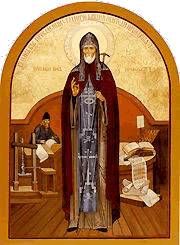
St. Job of Pochaev
Valiant preserver of Orthodoxy in the wake of the infamous Union of Brest
Holy Canons Relating to Ecumenism , excerpted from The Rudder.
Selected Excerpts from the Three Answers, or A Lesson On Endless Dialogue with the Heterodox: in an effort to show others how “ecumenical dialogue” has been conducted properly in the past, I include here selected texts from Dr. Constantine Cavarnos’ Ecumenism Examined, Archimandrite Cyprian’s Orthodoxy and the Ecumenical Movement, and the Three Answers of Patriarch Jeremiah II to the Lutheran Tübingen scholars regarding the “Augsburg Confession” (16th century). See also “St. John of Damascus and the ‘Orthodoxy’ of the Non-Chalcedonians”, in the Monophysite section below.
Patriarchal and Synodical Encyclical of 1848
, A Reply to the Epistle of Pope Pius IX, “to the
Easterns.”
Patriarchal and Synodical Encyclical of 1895
, A Reply to the Papal Encyclical of Pope Leo XIII (1895)
on Reunion.
Patriarchal and Synodical Encyclical of 1920
: this infamous and un-Orthodox document
continues to be the platform from which ecumenism is justified by many
of the Orthodox Churches (see critique, below). One is forced to ask,
“Where are all the other Encyclicals that have been given in the
past? Why are only (as of April, 2, 1997) the Encyclicals of 1902 and
1920 on this site? Where are the clear affirmations of the Orthodox Church
as the ”One, Holy, Catholic and Apostolic Church“ as declared
in the Encyclical of the Eastern Patriarchs (1848) and the Patriarchal
Encyclical of 1895?”
The Patriarchal Encyclical of 1920: A Collection of Short Critiques
Masonry: The Official Statement of the Church of
Greece (1933) : masonry is one of the foundational religions
of the World Council of Churches. For other foundational groups see Met.
Vitaly’s report entitled “Ecumenism”.
See also this Pastoral Encyclical on Masonry,
Bishop Ephraim of Boston.
The Oberlin Statement , “Christian Unity as Viewed
by the Eastern Orthodox Church.” Statement of the Representatives of the Greek Orthodox Church
in USA at the North American Faith and Order Study Conference, Oberlin,
Ohio, September 3-10, 1957.
Ecumenism , by Archbishop
Vitaly of Montreal and Canada. Delivered as an official report to the
full Sobor (Council) of Bishops of the Russian Orthodox Church Outside
of Russia (1967).
Uppsala and Orthodoxy , by
Fr. Gregory Grabbe. A critique of the WCC Assembly which took place July
4-20, 1968, in Uppsala—an event which marked a turning point in the
Orthodox involvement in the Ecumenical Movement.
The Epistles of Metropolitan Philaret :
this page contains a series of “Sorrowful Epistles” and other
works that were written in the sixties.
Ecumenical Doxology with
Archbishop Iakovos
,
Sunday, January 26, 1969. This was sent by a friend of the
Orthodox Christian Information Center. For those who have always wondered
what went on at these infamous events, this will be an eye-opener.
The Announcement of the Extraordinary Joint Conference of
the Sacred Community of the Holy Mount Athos concerning
ecumenism (April, 1980).
Report from the Council of Bishops of 1983. By Archbishop Vitaly of Montreal and Canada. Includes the Anathema issued at that time with later pastoral remarks by Archpriest Alexander Lebedeff.
Firm Declarations of Patriarch
Diodoros (1992) : This is the full text of the unwavering positions and Orthodox convictions
of the Most Holy Mother of the Churches, the Ancient Patriarchate of Jerusalem,
which was deposited and entered into the minutes of the assembly of Orthodox
leaders at the Phanar on the Sunday of Orthodoxy, 1992, by His Most Reverend
Beatitude, the Venerable Patriarch Diodoros I. This is especially
helpful for understanding the controversial issue of protracted “dialogue”
with the heterodox.
The Balamand Agreement (1993) : the full text of this ecumenical
document along with numerous critiques.
A Brief History of the WCC and the Relation of the
Serbian Orthodox Church to the WCC : A report written at the request
of the Holy Synod of the Serbian Church and submitted to the Serbian Orthodox
Patriarchate on November 17, 1994, by Bishop Artemije, a spiritual son
of Blessed Justin (Popovich). The report follows a short article entitled
“Uneasiness in the Serbian Patriarchate.”
The Thessaloniki Summit (May, 1998)
: “The Inter-Orthodox Meeting on Evaluation of New Facts
in the Relations of Orthodoxy and the Ecumenical Movement.” The original report, with critical notes.
The Statement on the Relationship
of the Orthodox Church to the World Council of Churches (June, 1998)
: by the Orthodox Theological
Society in America (OTSA). The original report, with critical notes.
The Official Conclusions of the September, 2004 conference “Ecumenism: Origins, Expectations, Disenchantment”, sponsored by the School of Pastoral Theology, The Aristotelian University, Thessaloniki, Greece. Among the concluding proposals of the conference participants we read:
“That it be made manifest to church leaders everywhere that, in the event that they continue to participate in, and lend support to, the pan-heresy of Ecumenism - both inter-christian and inter-religious - the obligatory salvific, canonical and patristic course for the faithful, clergy and laity, is excommunication: in other words, ceasing to commemorate bishops, who are co-responsible for, and co-communicants with, heresy and delusion. This is not a recourse to schism but rather to a God-pleasing confession, just as the ancient Fathers, and bishop-confessors in our own day have done, such as the esteemed and respected former Metropolitan of Florina, Augustinos, and the Fathers of the Holy Mountain (Athos).”
The Official Statement from Mt. Athos on the Pope’s Visit to the Phanar (2006).
An Open Letter to the Holy Abbots and the Holy Representatives of the Sacred Twenty Monasteries in the Holy Community of the Holy Mount Athos. The So-Called “Kelliotes Letter” (December, 2006).