

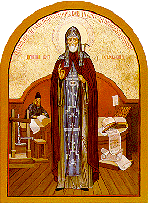
An Excerpt From the Life of St. Job of Pochaev
Commemorated on October 28th
Acquiring the patient endurance of the long-suffering forefather, emulating the abstinence of the Baptist, and sharing in the divine zeal of both, thou wast vouchsafed worthily to receive their names, and wast a fearless preacher of the true Faith. Wherefore, thou didst lead a multitude of monks to Christ, and didst confirm all the people in Orthodoxy. O Job our venerable father, pray thou that our souls be saved. Twice.
—Troparion, in Tone IV
Thou wast shown to be a pillar of the true Faith, a zealot of the commandments of the Gospel, the reproof of pride, and an intercessor and instructor for the lowly. Wherefore, beg thou forgiveness of sins for those who bless thee, and preserve thy monastery unharmed, O Job our father, who art like unto the longsuffering one of old.
—Kontakion, in Tone IV, Spec. Mel: “Thou hast appeared today to the whole world”
The Orthodox Books Published at the Pochaev Printing Press During the Abbacy of Saint Job
It is well known that from the very earliest times an Orthodox printing press existed at the Pochaev Monastery in Volhynia, on which, based on privileges granted it by the kings of Poland, divers books were printed in the Slavonic, Latin and Polish languages. Tradition ascribes the establishment of this press to Anna Goiskaya, the foundress of the Pochaev Monastery. When the venerable Job arrived at Mount Pochaev, this printing press was already flourishing: its typefaces were beautiful, similar to the type styles in use at the printing press of the Lavra of the Kiev Caves during the same period; special calligraphic letters were used to begin articles; there were various vignettes, end-designs and borders which were used for the opening and closing pages, and so forth. One need not describe the sympathy with which the venerable Job must have treated this establishment, which then gave him the possibility to disseminate useful books not only by means of copying, as he did at the Dubno monastery, but also by printing them for anyone who desired them. An opportune occasion soon presented itself to the blessed one for the achievement of this goal. At that time, at the Stauropighial Brotherhood of the Dormition of the All-holy Theotokos, in L’vov, Cyril Trankvillion-Stavrovetsky, who was subsequently archimandrite in Chernigov, but is famous in the history of Orthodox religious literature, was the pedagogue and preacher. Among his various other writings, Trankvillion authored The Mirror of Theology, which was directed against the Latins; and with the blessing of the venerable Job, this book was "published in the Monastery of Pochaev, on the lands of His Grace, Lord Andrew Firlej, in the year 1618, on the 12th day of the month of March."
Thus, during the tenure of the venerable Job, the Pochaev press printed leaflets containing the order of proskomedia for distribution among the Orthodox parishes, letters and epistles of the Orthodox hierarchs, various prayers, etc. And finally, because of the scarcity of Orthodox printing establishments within the confines of the south-western area of Russia at that time, when, as history bears witness, all "the most ancient printing presses of Volhynia—those at Ostrog, Kremenets, Rakhmanovsk, and others—one after another ceased their activity and existence by the first half of the 17th century, and only the Pochaev Press was still publishing in the Slavono-Russian language in Volhynia", the Monastery of Pochaev found it possible to distribute the products of its press among the Orthodox, and thus certainly aided in supporting the Orthodox Church as much as possible amid the tribulations then inflicted upon it by the Latins.
Saint Job as an Author & Apologist for Orthodoxy
Yet this is only a small part of the saint’s contributions. From of old there has been preserved in the Lavra of Pochaev a manuscript book entitled The Book of the Blessed Job Zhelezo, Abbot of Pochaev, Written in His Own Hand. A perusal of this book shows that the venerable Job not only published the books of others, but that he himself entered the field of ecclesiastical literature as dictated by his position as abbot of the monastery and champion of the Orthodox Faith. That this manuscript is a genuine product of the hand of Saint Job is beyond doubt, due to the following circumstances. As we have already said above, in "The Life of the Venerable Job", authored by his disciple Dositheus, it states directly that while the favorite of God was living in Dubno, "he exercised himself in the writing of ecclesiastical books…" It is to be understood that this manuscript must have been one of those mentioned, the moreso in that this book was written partly in uncials, partly in semiunctial letters directly akin to the cursive script which the venerable Job used when signing the testament of Irene Yarmolinskaya in 1646, and which has been preserved at the Pochaev Lavra to this day. Several letters of his handwriting, despite the difference between it and the semiunctials, are nonetheless significantly similar in both documents, and other cursive letters, patently dissimilar to the semiunctials, were easily formed from the latter by the natural process of melding the semiunctial letters into cursive script. To this one must add the tradition that this manuscript belongs to the pen of the venerable Job himself and dates to the 17th century.
This manuscript has not come down to us intact. In its present state it comprises 123 pages (in longitudinal octavo). But the remnants of the original pagination indicate that it formerly included more than 900 pages. Nevertheless, even the comparatively little which has survived has extraordinarily important historical and literary value.
The contents of the venerable Job of Pochaev’s book, so far as one can judge from its surviving pages, may be divided into the following four sections: 1) lives of the saints, their sayings, and sermons for the immovable feasts and major days of the ecclesiastical calendar for the months of August, September and December; 2) selections from the paterica, especially from The Ladder of St. John Climacus; 3) sermons and discourses for Passion and Bright Weeks, and for several moveable feasts and important days of the Church’s year; and 4) extracts from various books, without headings or indication of sources, notes and short instructions borrowed and compiled, both imitative and original, not assigned to any particular day, which one may characterize as instructions for various occasions. This latter section is especially important, since it is here that the venerable Job’s independent experience in didactic activity is to be found.
In the opinion of Professor Petrov, who edited Saint Job’s manuscript for publication in 1883, the chief value of the saint’s manuscript anthology lies not in the fact that it is an incomplete collection of extracts from books available to the venerable Job, but that, in and of itself, it is an expression of the character of the personality of the venerable Job and his era. The transcribed, compiled and imitative articles in the venerable one’s book reveal and define that scope of views and understandings which the mind of the saint took in, and by which his moral nature was nurtured. On the other hand, the contents of the book represent a particular choice from various sources of such edifying material, which, corresponding to the personal character and tastes of the saint, furthermore had a more or less direct and close relation to the circumstances of time and place in the life of the venerable Job. In this case, Saint Job’s choice of edifying articles for his book reveals his definite goals, and a certain direction and independent thought which, even in the articles he borrowed, places him on the same level as independent preachers of the word of God.
In the manuscript of the venerable Job of Pochaev there are teachings and extracts of writings directed against the Jews, Catholics and divers Protestant sects. However, there are only two denunciations against the Jews and Catholics here, borrowed, moreover, from Gregory Tsamblak. The main efforts of Saint Job were directed toward the denunciation of the Protestant sects, especially Socinianism, which at that time (the end of the 16th and the beginning of the 17th centuries) was rapidly spreading throughout south-western Russia. The venerable Job conducts a wide polemical battle against Socinius, defending the most important dogmas of the Orthodox Church which were rejected by the heretics. Thus, in the saint’s manuscript, there is (to counter Socinius) an exposition of the dogmas of: 1) the all-holy Trinity, 2) the divinity of Jesus Christ, 3) the true divinity and manhood of Jesus Christ, 4) the all-holy Theotokos, 5) baptism, 6) the all-pure Mysteries of the Body and Blood of our Lord Jesus Christ, 7) images or icons, 8) the praise and veneration of the holy favorites of God, 9) fasting, 10) the commemoration of the departed, 11) the temples of God, 12) the passions of men and the necessity of good works for man’s soul, 13) monasticism, etc.
In Professor Petrov’s opinion, Saint Job’s polemical and apologetical work against the Protestant sectarians must occupy a place of honor in the Orthodox anti-Lutheran polemics of the second half of the 16th century, in which they occurred. Having enumerated (although with quite a few omissions) the extant writings of Orthodox authors who denounced Antitrinitarianism or Socinianism during the period under study, Professor Petrov declares that, judging by the breadth of the polemic undertaken by the venerable Job, it can be compared only with the major works on the same subject produced at that time, namely: The Evidence of the Truth, by Zenobius Otensky, the epistles of the elder Artemius (1602), and The Book of the Faith, Saint Job’s polemic being distinguished, moreover, by its high inner value. And in certain respects, the polemic of the venerable Job must be assessed at an even higher value than these major works. Other denouncers of heretics and defenders of Orthodoxy—says Professor Petrov—either utilized Catholic texts (as, for example, the author of The Book of the Faith, who was guided by the polemical works of Vuiko), or while doing battle with heretical rationalism grounded themselves in rationalism, strove to refute the heretics by reasoned arguments, to out-argue them and compel them to acknowledge the truth of Orthodoxy (for example, Basil, cleric of Ostrog, and Stephen Zizanius); yet the venerable Job grounds himself wholly upon the sacred Scriptures, the Traditions of the Church and the writings of the holy fathers, upon the soil of the Church, and he does not so much prove as he discloses and clarifies the truths of Orthodoxy, and with their radiance he casts light upon the errors of the heretics. Those who set themselves on the slippery ground of Catholic or rationalistic proofs, were themselves liable to totter on that ground and sometimes went to the opposite extreme, going beyond the boundaries of strictly Orthodox theology (as happened with Stephen Zizanius and several others). On the contrary, Saint Job of Pochaev expressed his own theological thought through patristic writings, extracts from them and their expressions, and thus stood steadfastly upon Orthodox ground.
Yet in addition to this there are in Saint Job’s manuscript no few articles of his own composition—pithy, expressive and original—which are distinguished by a character of individual personality and by a direct relationship to the needs and requirements of his time, in addition to articles copied and borrowed from other sources. These articles are the following: 1) "For Palm Sunday, an Interpretation of the Gospel concerning Lazarus", composed in imitation of Saint John Chrysostom and Gregory Tsamblek, 2) "A Concluding Moral Teaching for the End of an Apocryphal Homily of Chrysostom for Palm Sunday", 3) "On Patience and Goodly Praise, and That We Not Grieve Excessively for the Departed", composed in imitation of the teaching of Chrysostom bearing the same title, 4) "On the Rich Man and Lazarus", composed in imitation of the sixth homily of Chrysostom bearing the same title, with extracts therefrom, 5) a short teaching "On the Seed and the Sower, and on Listening to the Word of God", composed in imitation of John Chrysostom’s homily on the working of the soil, 6) a teaching "On the Renunciation of the World and on Spiritual Perfection", based on extracts from the works of Basil the Great and John Chrysostom, 7) a didactic work "On Cain and Abel, Envy and Evil", based on three extracts from the works of John Chrysostom, 8) a didactic work "Against Drunkenness", based on the prophecy of Jeremiah, 9) "On the Veneration of the Holy Icons, from the Epistle of John of Damascus, or According to Others, from that of Theodore the Studite to the Emperor Theophilus, and From Other Sources", 10) a didactic work "On the Divinity and Manhood of Jesus Christ, His Incarnation, and on the Theotokos". Moreover, as Petrov says, in several of the homilies and discourses of Chrysostom for the days of Passion Week there are abbreviations, changes and additions also made by Job.
One should point out another peculiarity of the manuscript of the venerable Job: that it is written wholly in the Slavonic language, while almost all the other works of west-Russian ecclesiastical literature contemporary to it are written in Slavonic with an admixture of Ukrainian and Polish words. Its very contents show that this was a book that Saint Job used when delivering instructive talks to his brethren, most probably to augment his oral discourses. And since the venerable one came into contact principally with Protestants in the environs of the Monastery of Pochaev, especially in the person of Andrew Firlej, we incline to the opinion that this very manuscript, in that it bears the undeniable marks of anti-Lutheran polemics, was compiled by the saint at Pochaev, even though it may have been begun at Dubno, in view of the Protestant, and particularly the Socinian, propaganda which was then being brought to bear upon western Russia.
Saint Job’s Participation at the Council of Kiev in 1628
In 1620, the Orthodox Church in southern Russia was comforted by the appointment of a new Orthodox metropolitan to fill the place of the apostate Michael Rogoza. In that year, Patriarch Theophan of Jerusalem, who (on August 15th) consecrated Job Beretsky as Metropolitan of Kiev, also ordained a bishop (Isaacius Boriskovich) for the Diocese of Lutsk, to whose diocesan rule the Monastery of Pochaev had belonged from of old. All the more grievous for the Orthodox was the subsequent defection of Meletius Smotritsky, a prominent champion of the Orthodox Church, whom Patriarch Theophan, among others, had likewise consecrated as archbishop of the Diocese of Polotsk, Vitebsk and Moghilev. This happened shortly after the infamous persecutor of the Orthodox, Josaphat Kuntsevich, Uniate bishop of Vitebsk, was murdered (in 1623). The Uniates and the Jesuits accused Meletius of complicity in the murder. The king ordered the murderers executed,…and Meletius, who was not well known for his firmness of character, capitulated. Afterwards, he withdrew to the East, where he spent about three years. On the return trip from thence, Smotritsky appeared in Rome and cast himself at the feet of the pope, who issued a bull appointing him (titular) archbishop of Hierapolis . After this, Meletius established his residence in the Dermansk Monastery (1627), and soon began to write against the Orthodox Church. Thus, in 1628, at the Dermansk Monastery he entrusted to the Uniate Cassian Sakovich, Archimandrite of the Monastery of the Savior in Dubno, his "Apologia for My Journey Throughout the Lands of the East", in which Meletius not only expressed the desire that the Eastern Church unite with that of the West, but lodged various slanders against the Eastern Church and the Russian defenders of Orthodoxy. Therein he also began to condemn his own previously articles, which he had written to advance the cause of Orthodoxy.
When he learned of this, Metropolitan Job Boretsky hastened to convoke an ecclesiastical Council to meet in Kiev in 1628, summoning all the Orthodox bishops, archimandrites and abbots of western Russia to meet on August 15th. Moreover, he had to announce the prescription, received from King Sigismund III’s royal diet, for the collection of funds to underwrite the cost of a war with Russia, over the accession of Tsar Michael Romanov to the throne. Obedient to the summons of their archpastor, and even more zealous for the glory of the Orthodox Church, the venerable Job and the others left in good time, so as to arrive in Kiev by the appointed day, and there, during the course of the Council, he had the consolation of witnessing Meletius’ renunciation of the Unia on August 15th, when, during a service with the metropolitan in the Church of the Dormition of the All-holy Theotokos, the main church of the Lavra of the Kiev Caves, he trampled his own Apologia underfoot, and then participated in pronouncing anathema upon Archimandrite Cassian Sakovich, the publisher of Meletius’ uniate writings.
The next day, August 16th, a conciliar declaration was made in the name of the Council, in which all present at the Council stated that they "were all standing firmly in the Eastern Orthodox Faith, were not considering defecting to the Unia, and promised under oath not to give it up, but to urge all the Orthodox people to adhere to it." This declaration was presented to all present at the Council to sign, and among the signatures of the metropolitan and the other high ecclesiastical dignitaries, such as Bishop Isaacius of Lutsk, the famous Peter Moghila (at that time archimandrite of the Lavra of the Kiev Caves), and others, the blessed Job wrote his own name, "John Zhelezo, Abbot of Pochaev".
From Saint Job of Pochaev (Liberty, TN: St. John of Kronstadt Press, 1997), pp. 24-31. Reprinted with permission from Fr. Gregory Williams and the translator, Reader Isaac E. Lambertsen. Saint Job is the Patron Saint of the Print Shop at Holy Trinity Monastery in Jordanville, NY. This print shop is the direct heir of the one begun under Saint Job's leadership. It continues to be the most important publishing center of the Russian Orthodox Church in the world.