

Death & the Future Life: The Writings of the Saints
This section contains homilies and other writings, as well as Lives of Saints, which relate to our theme
On the Incarnation of the Logos, by St. Athanasius the Great. An excellent English edition of this classic work has been published by St. Vladimir Seminary Press. It includes a superb Introduction by C. S. Lewis.
A Homily on Life After Death, by St. John of Shanghai and San Francisco, with comments by Fr. John Mack.
Homilies 31, 34, and 53 on the Gospel of St. Matthew, by St. John Chrysostom
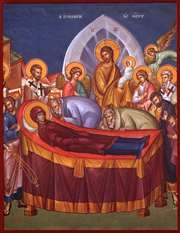
The Dormition of the Most Holy Theotokos
Christ holding the all-luminous soul of Mary, depicted in the form of a child |
Homilies 39, 40, 41, and 42 on 1 Corinthians 15, by St. John Chrysostom
Commentary on the Last Judgement, from The Explanation by the Blessed Theophylact, The Gospel According to St. Matthew, Chapter 25:41-46.
Commentary on the Parable of the Rich Man and Lazarus, from The Explanation by the Blessed Theophylact (St. Luke 16)
The Journey Beyond Death: St. Theodora's Journey Through the Aerial Toll-Houses
The Lives of Sts. Justina and Cyprian: Christianity vs. Sorcery.
The Life of St. Salvius: Seer of Heavenly Mysteries
St. Mark of Ephesus on the State of Souls After Death: Against the Roman Catholic Doctrine of Purgatory. Excerpts from his homilies given at the 15th century Pseudo-Synod of Ferrara-Florence.
"Condemned" to be Immortal, by St. Justin (Popovich) of Chelije.
Concerning the Resurrection, by St. John of Damascus
Concerning Angels, by St. John of Damascus. See also The Church's Teaching Concerning Angels, from Orthodox Life.
The Life of St. Columba, by St. Adamnan. See Book III, Of the Visions of Angels
The Ecclesiastical History of the English Nation, by St. Bede. See especially Book V, Ch. 12, 13, and 15 for events related to our theme. (Note: Book V is not yet online, but should be soon. Consult a paperback edition until then.)
The Life of St. Cuthbert, by St. Bede. See esp. Ch. IV, "How, In Company With Shepherds, He Saw the Soul of Bishop Aidan Carried to Heaven by Angels," and Ch. XXXIV.
The Life of St. Anthony, by St. Athanasius the Great. One of the most famous classics of Christian antiquity. A book which became the model for all hagiographical literature. See Sections 59-60, and 65-66 for events related to our theme.
When Thou hadst fallen asleep in the flesh as one mortal, O King and Lord, Thou didst rise again on the third day, raising up Adam from corruption, and abolishing death: O Pascha of incorruption! O Salvation of the world!
—Exapostilarion for the Sunday of Pascha
It is the day of Resurrection, let us be radiant, O ye peoples; Pascha, the Lord's Pascha; for Christ God hath brought us from death unto life, and from earth unto Heaven as we sing the triumphal hymn.
—Heirmos for Ode One, Paschal Canon
Let us arouse in ourselves the remembrance of death by visiting cemeteries, visiting the sick, being present at the death and burial of our close ones, by frequently examining and renewing in our memories various contemporary deaths which we have heard of or seen.... Having understood the shortness of our earthly life and the vanity of all earthly acquisitions and advantages; having understood the frightful future that awaits those who have disdained the Redeemer and redemption and have offered themselves entirely as a sacrifice to sin and corruption—let us turn our mental eyes away from their steady gazing at the deceptive and enchanting beauty of the world which easily catches the weak human heart and forces it to love and serve it; let us turn them to the fearful but saving spectacle of the death that awaits us. Let us weep over ourselves while there is time; let us wash, let us cleanse with tears and confession our sins which are written in the books of the Sovereign of the world. Let us acquire the grace of the Holy Spirit—this seal, this sign of election and salvation; it is indispensable for a free passage through the spaces of the air and for entrance into the heavenly gates and mansions.... O ye who have been banished from Paradise! It is not for enjoyments, not for festivity, not for playing that we find ourselves on earth—but in order that by faith, repentance, and the Cross we might kill the death which has killed us and restore to ourselves the lost Paradise! May the merciful Lord grant the readers of this Homily, and him who has composed it, to remember death during this earthly life, and by the remembrance of it, by the mortification of oneself to everything vain, and by a life lived for eternity, to banish from oneself the fierceness of death when its hour shall come, and through it to enter into the blessed, eternal, true life. Amen.
—Conclusion of a Homily on Death, by St. Ignaty Brianchaninov.
From his Collected Works, Vol. III, pp. 181-183. (Translation taken from The Soul After Death, p. 172.)