Ecumenism Awareness: False Union With Rome
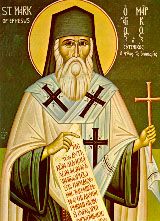
St. Mark of Ephesus
Read about his involvement in the Council of Florence, and the aftermath to his repose...
Some of our hierarchs and “professional theologians” today call Rome a “Sister Church”. They will tell you that there is a “new openness” to Rome, that we “understand things better in light of new developments” (e.g., “eucharistic ecclesiology”). For example, here is a quote from Bishop Maximos of Pittsburgh, a person whom many consider to be one of the most conservative and erudite bishops in the GOA. The quote is from his Foreward to The Quest for Unity: Orthodox and Catholics in Dialogue (Crestwood, NY: St. Vladimir Seminary Press and Washington, DC: United States Catholic Conference, 1996), ed. by John and John Borelli:
Common prayer and participation as far as possible in the prayer life of the other church has also been part of our lives together in dialogue... We have responded to the work of the Joint Theological Commission for the dialogue between our two sister churches, the “two lungs” of the one Church of Christ. These two have to synchronize anew their breathing, so that the Church of Christ may begin breathing properly again. (p. 3).
The books and articles below will leave no doubt in your mind how the Church views Roman Catholicism. Although there has not been an official synodal declaration that it is heretical, there is no doubt that the consensus of the Holy Fathers concerning Roman Catholicism is such that an “official declaration” is a formality, a kin to the Church officially glorifying a Saint who is already widely acknowledged and venerated as such by the pious pleroma of the Faithful.
If you do not have the time to study this matter, at least read one or both of the patriarchal encyclicals.
Recommended Books
The Question of Union: A forthright discussion of the possibility of union of the Eastern Orthodox Church and Roman Catholicism, by Dr. Constantine Cavarnos. See sidebar.
The Rush to Embrace (St. Nikodemos Publication Society), by Archpriest Alexey Young.
My Exodus from Roman Catholicism, by Bishop Paul de Ballester. Translated by Constantine Zalalas.
Against False Union, by Dr. Alexander Kalomiros.
The History of the Council of Florence, by Ivan Ostroumoff.
Guette, Abbe, The Papacy: Its Historic Origin and Primitive Relations with the Eastern Church [PDF, 1.4 megs]. New York: Minos Publishing Company, 1866. Though this is an old book, it has seen numerous reprints and can still be found with a little searching. It is the most thorough and reliable treatment of the Papacy from an Orthodox position.
Other books and articles listed on the “For Roman Catholics” page in the Inquirers section of the site.
Miscellaneous Articles
Encyclical of the Eastern Patriarchs (1848): A Reply to the Epistle of Pope Pius IX, “to the Easterns.”
Patriarchal Encyclical of 1895: A Reply to the Papal Encyclical of Pope Leo XIII (1895) on Reunion.
St. Mark of Ephesus and the False Union of Florence, by Archimandrite Amvrossy Pogodin.
A Protest to Patriarch Athenagoras: On the Occasion of the Lifting of the Anathemas of 1054 (December, 1965). See also the numerous Sorrowful Epistles and other writings of Metropolitan PHILARET.
A Desperate Appeal to the Ecumenical Patriarch: by the Blessed Elder Philotheos Zervakos (1968). On hasty false union with Rome.
The Announcement of the Extraordinary Joint Conference of the Sacred Community of the Holy Mount Athos, concerning union with Rome (1980).
The Official Statement from Mt. Athos on the Pope’s Visit to the Phanar (2006).
An Open Letter to the Holy Abbots and the Holy Representatives of the Sacred Twenty Monasteries in the Holy Community of the Holy Mount Athos. The So-Called “Kelliotes Letter” (December, 2006).
The Papacy and Its Unholy State: A Worldwide Wake-up Call to Orthodox Leaders, By Raphael Masterjohn, from “The Light of Orthodoxy,” Vol. 1, No. 1 (07/15/2007).
Key Reading
|
Ecumenism and the Orthodox Church, by Protopresbyter Theodore Zissis. This article by one of the foremost theologians and professors in Greece rightly criticizes the 2006 meeting in Constantinople of Patriarch Bartholomew and Pope Benedict XVI.
Letter from Metropolitan Seraphim of Piraeus (Church of Greece) to the Papist Bishop of Syros Island. Translated from the Greek newspaper Orthodox Press, November, 2007. In these confusing times of “ecumenical dialog,” thank God for Orthodox Hierarchs who clearly state the Church’s position viz-a-viz Roman Catholicism. This Bishop knows and acts upon what another Bishop recently and so eloquently stated: “True love for a Christian is to secure eternal life for one’s neighbor, which means you straightforwardly say he is in error, and try to return him to the truth, directing him onto the path of salvation.” See also this subsequent article by Fr. Theodore Zissis in praise of the Metropolitan’s letter.
Firm Declarations of Patriarch Diodoros: This is the full text of the unwavering positions and Orthodox convictions of the Most Holy Mother of the Churches, the Ancient Patriarchate of Jerusalem, which was deposited and entered into the minutes of the assembly of Orthodox leaders at the Phanar on the Sunday of Orthodoxy, 1992, by His Most Reverend Beatitude, the Venerable Patriarch Diodoros I. This is especially helpful for understanding the controversial issue of protracted “dialogue” with the heterodox.
Articles Critiquing the Balamand Agreement.
Are Protestantism and Roman Catholicism Heretical?: compiled by Patrick Barnes.
Zealots of Orthodoxy: Part of Chapter 52 from Father Seraphim Rose: His Life and Works, wherein [then] Eugene Rose comments on the movement for a false union with Rome during the mid-Sixties.
St. Gregory Palamas and the Pope of Rome: from an Orthodox Tradition Q&A, vol. XIII, no. 2. “Hesychasm is a direct condemnation of Papism.”
Florence 2000?: An Open Letter To All Roman Catholics and Orthodox On The State of Rome and Orthodoxy, by Father Alexey Young.
Papism as the Oldest Protestantism: by the Blessed Father Justin (Popovich).
Concerning the Latins (Roman Catholics) and Their Baptisms: An excerpt from The Rudder by Saint Nikodemos the Hagiorite.
The Vatican and Russia, by Deacon Herman Ivanov-Treenadzaty. This article is very favorably cited by Hieromonk Patapios Hagiogregorites in a forthcoming article for Orthodox Tradition which touches on the Uniate problem. Appended to it is a short article on Josaphat the Malevolent, considered a Saint by the Roman Catholics.
The Tragedy of Our Uniate Brothers, by Hieromonk [now Bishop] Auxentios.

Such are, briefly, the serious and arbitrary innovations concerning the faith and the administrative constitution of the Church, which the Papal Church has introduced and which, it is evident, the Papal Encyclical purposely passes over in silence. These innovations, which have reference to essential points of the faith and of the administrative system of the Church, and which are manifestly opposed to the ecclesiastical condition of the first nine centuries, make the longed-for union of the Churches impossible: and every pious and orthodox heart is filled with inexpressible sorrow on seeing the Papal Church disdainfully persisting in them, and not in the least contributing to the sacred purpose of union by rejecting those heretical innovations and coming back to the ancient condition of the one holy, catholic and apostolic Church of Christ, of which she also at that time formed a part.... [A]s has been said before, the Western Church, from the tenth century downwards, has privily brought into herself through the papacy various and strange and heretical doctrines and innovations, and so she has been torn away and removed far from the true and orthodox Church of Christ.
—From the Patriarchal Encyclical of 1895,
the response to the Papal Encyclical of Pope Leo XIII on the subject of reunion
(emphasis mine).
What has changed in Roman Catholicism that would make this wholly Orthodox encyclical
“outdated”?
That the Latins are heretics there is no need of our producing any proof for the present....Enough was said concerning them by St. Mark of Ephesus in Florence (at the twenty-fifth general assembly), who spoke frankly as follows: We have split ourselves off from the Latins for no other reason than the fact that they are not only schismatics but also heretics.“ Wherefore we must not even think of uniting with them.
—St. Nikodemos the Hagiorite, from ”Concerning the Latins (Roman Catholics) and Their Baptisms“ (emphasis mine).
Q: One could conclude that there are various theological views within Orthodoxy about co-operation with Roman Catholic Church since, based on the facts, Orthodox theologians also participated in the works of the International Commissions, while the [Ravenna] document has been harshly criticized by their brothers.
A: There exist only those persistent in their confession of Faith and those ready for various kinds of compromise, abatement, and condescension. Many Orthodox participants at those ecumenical gatherings are not confessors of their faith; accordingly, they can not represent the teaching of the Orthodox Church. If they were in fact worthy representatives of the Orthodox Church and Orthodox Teaching, they would, above all, listen to the Apostle Paul who says, ”to stay away from a heretical man after the first and second approaches.“ How far are we going to go with those dialogs, commissions — until there is no end? Are we there counseling those in heresy, in delusion? No, we are seeking to compromise with them. True love for a Christian is to secure eternal life for one’s neighbor, which means you straightforwardly say he is in error, and try to return him to the truth, directing him onto the path of salvation. Encouraging someone to remain in his delusion is not love, but hatred, according to St. Maximus the Confessor.
—From an interview with His Grace, Bishop Artemije of Raska and Prizren (Serbian Orthodox Church)
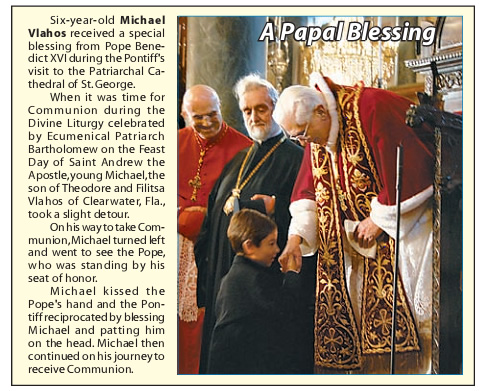
A lamentable picture from the December, 2006 issue of
Orthodox Observer,
the official publication of the Greek Orthodox Archdiocese of America