

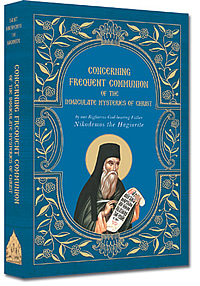
Frequent Reception of the Holy Mysteries is Beneficial and Salvific
Part II, Chapter 2 from Concerning Frequent Communion
by St. Nikodemos the Hagiorite
Both the soul and the body of the Christian receive great benefit from the divine Mysteries—before he communes, when he communes, and after he communes. Before one communes, he must perform the necessary preparation, namely, confess to his Spiritual Father, have contrition, amend his ways, have compunction, learn to watch over himself carefully, and keep himself from passionate thoughts (as much as possible) and from every evil. The more the Christian practices self-control, prays, and keeps vigil, the more pious he becomes and the more he performs every other good work, contemplating what a fearful King he will receive inside of himself. This is even more true when he considers that he will receive grace from Holy Communion in proportion to his preparation. The more often someone prepares himself, the more benefit he receives. [93]
When a Christian partakes of Communion, who can comprehend the gifts and the charismata he receives? Or how can our inept tongue enumerate them? For this reason, let us again bring forward one by one the sacred teachers of the Church to tell us about these gifts, with their eloquent and God-inspired mouths.
Gregory the Theologian says:
When the most sacred body of Christ is received and eaten in a proper manner, it becomes a weapon against those who war against us, it returns to God those who had left Him, it strengthens the weak, it causes the healthy to be glad, it heals sicknesses, and it preserves health. Through it we become meek and more willing to accept correction, more longsuffering in our pains, more fervent in our love, more detailed in our knowledge, more willing to do obedience, and keener in the workings of the charismata of the Spirit. But all the opposite happens to those who do not receive Communion in a proper manner. [94]
Those who do not receive Communion frequently suffer totally opposite things, because they are not sealed with the precious blood of our Lord, as the same Gregory the Theologian says: “Then the Lamb is slain, and with the precious blood are sealed action and reason, that is, habit and mental activity, the sideposts of our doors. I mean, of course, by ‘doors,’ the movements and notions of the intellect, which are opened and closed correctly through spiritual vision.” [95]
St. Ephraim the Syrian writes:
Brothers, let us practice stillness, fasting, prayer, and tears; gather together in the Church; work with our hands; speak about the Holy Fathers; be obedient to the truth; and listen to the divine Scriptures; so that our minds do not become barren (and sprout the thorns of evil thoughts). And let us certainly make ourselves worthy of partaking of the divine and immaculate Mysteries, so that our soul may be purified from thoughts of unbelief and impurity, and so that the Lord will dwell within us and deliver us from the evil one.
The divine Cyril of Alexandria says that, because of divine Communion, those noetic thieves the demons find no opportunity to enter into our souls through the senses:
You must consider your senses as the door to a house. Through the senses all images of things enter into the heart, and, through the senses, the innumerable multitude of lusts pour into it. The Prophet Joel calls the senses windows, saying: “They shall enter in at our windows like a thief” (Jl. 2:9), because these windows have not been marked with the precious blood of Christ. Moreover, the Law commanded that, after the slaughter (of the lamb), the Israelites were to smear the doorposts and the lintels of their houses with its blood, showing by this that the precious blood of Christ protects our own earthly dwelling-place, which is to say, our body, and that the death brought about by the transgression is repelled through our enjoyment of the partaking of life (that is, of life-giving Communion). Further, through our sealing (with the blood of Christ) we distance from ourselves the destroyer. [96]
The same divine Cyril says in another place that, through Communion, we are cleansed from every impurity of soul and receive eagerness and fervor to do good: “The precious blood of Christ not only frees us from every corruption, but it also cleanses us from every impurity lying hidden within us, and it does not allow us to grow cold on account of sloth, but rather makes us fervent in the Spirit.” [97]
St. Theodore the Studite wondrously describes the benefit one receives from frequent Communion:
Tears and contrition have great power. But the Communion of the sanctified Gifts, above all, has especially great power and benefit, and, seeing that you are so indifferent towards it and do not frequently receive it, I am in wonder and great amazement. For I see that you only receive Communion on Sundays, but, if there is a Liturgy on any other day, you do not commune, though when I was in the monastery each one of you had permission to commune every day, if you so desired. But now the Liturgy is less frequently celebrated, and you still do not commune. I say these things to you, not because I wish for you simply to commune—haphazardly, without preparation (for it is written: ”But let a man examine himself, and so let him eat of the Bread, and drink of the Cup. For he that eateth and drinketh unworthily, eateth and drinketh damnation to himself, not discerning the Lord’s body and blood” [1 Cor. 11:28-29]). No, I am not saying this. God forbid! I say that we should, out of our desire for Communion, purify ourselves as much as possible and make ourselves worthy of the Gift. For the Bread which came down from heaven is participation in life: ”If any man eat of this bread, he shall live for ever: and the bread that I will give is My flesh, which I will give for the life of the world” (Jn. 6:51). Again He says: ”He that eateth My flesh, and drinketh My blood, dwelleth in Me, and I in him” (Jn. 6:58).
Do you see the ineffable gift? He not only died for us, but He also gives Himself to us as food. What could show more love than this? What is more salvific to the soul? Moreover, no one fails to partake every day of the food and drink of the common table. And, if it happens that someone does not eat, he becomes greatly dismayed. And we are not speaking here about ordinary bread, but about the Bread of life; not about an ordinary cup, but about the Cup of immortality. And do we consider Communion an indifferent matter, entirely unnecessary? How is this thought not irrational and foolish? If this is how it has been up until now, my children, I ask that we henceforth take heed to ourselves, and, knowing the power of the Gift, let us purify ourselves as much as possible and partake of the sanctified Things. And if it happens that we are occupied with a handicraft, as soon as we hear the sounding-board calling us to Church, let us put our work aside and go partake of the Gift with great desire. And this (that is, frequent Communion) will certainly benefit us, for we keep ourselves pure through our preparation for Communion. If we do not commune frequently, it is impossible for us not to become subject to the passions. Frequent Communion will become for us a companion unto eternal life. [98]
So, my brothers, if we practice what the divine Fathers have ordered and frequently commune, we not only will have the support and help of divine grace in this short life, but also will have the angels of God as helpers, and the very Master of the angels Himself. Furthermore, the inimical demons will be greatly distanced from us, as the divine Chrysostom says:
Let us then return from that Table like lions breathing fire, having become fearsome to the devil, thinking about our Head (Christ) and the love He has shown for us.... This blood causes the image of our King to be fresh within us, it produces unspeakable beauty, and, watering and nourishing our soul frequently, it does not permit its nobility to waste away.... This blood, worthily received, drives away demons and keeps them far from us, while it calls to us the angels and the Master of angels. For wherever they see the Master’s blood, devils flee and angels run to gather together.... This blood is the salvation of our souls. By it the soul is washed, is made beautiful, and is inflamed; and it causes our intellect to be brighter than fire and makes the soul gleam more than gold....Those who partake of this blood stand with the angels and the powers that are above, clothed in the kingly robe itself, armed with spiritual weapons. But I have not yet said anything great by this: for they are clothed even with the King Himself. [99]
Do you see, my beloved brother, how many wonderful charismata you receive if you frequently commune? Do you see that with frequent Communion the intellect is illumined, the mind is made to shine, and all of the powers of the soul are purified? If you also desire to kill the passions of the flesh, go to Communion frequently and you will succeed. Cyril of Alexandria confirms this for us: “Receive Holy Communion believing that it liberates us not only from death, but also from every illness. And this is because, when Christ dwells within us through frequent Communion, He pacifies and calms the fierce war of the flesh, ignites piety toward God, and deadens the passions.” [100]
Thus, without frequent Communion we cannot be freed from the passions and ascend to the heights of dispassion; just as the Israelites, if they had not eaten the passover in Egypt, would not have been able to be freed. For “Egypt” means an impassioned life, and if we do not frequently receive the precious body and blood of our Lord (every day if it be possible), we will not be able to be freed from the noetic Pharaonians (that is, the passions and the demons). According to Cyril of Alexandria,
As long as those of Israel were slaves to the Egyptians, they slaughtered the lamb and ate the passover. This shows that the soul of man cannot be freed from the tyranny of the devil by any other means except the partaking of Christ. For He Himself says: ”If the Son therefore shall make you free, ye shall be free indeed” (Jn. 8:36). [101]
Again St. Cyril says, “They had to sacrifice the lamb, being that it was a type of Christ, for they could not have been freed by any other means.” [102]
So if we also desire to flee Egypt, namely, dark and oppressive sin, and to flee Pharaoh, that is, the noetic tyrant (according to Gregory the Theologian), [103] and inherit the land of the heart and the promise, we must have as our general (as the Israelites had Joshua [Jesus] the son of Nun as their general) our Lord Jesus Christ through the frequent reception of Communion. This way we will be able to conquer the Canaanites and the strangers, which are the disruptive passions of the flesh, and the Gibeonites, which are deceptive thoughts, in order that we may be able to remain in Jerusalem, which is interpreted “sacred peace” (as opposed to the peace of the world), as our Lord says: “My peace I give unto you: not as the world giveth, give I unto you” (Jn. 14:27). That is to say, “My own peace I give to you, O my disciples, the sacred and holy peace, not the peace which is of the world, which oftentimes looks also to wickedness.”
Remaining in that sacred peace, we will be deemed worthy to receive inside our heart the promise of the Spirit, just as the Apostles remained and waited in Jerusalem, according to the command of the Lord, and received the perfection and grace of the Spirit on the day of Pentecost. And peace is a charisma which attracts all of the other divine charismata; and the Lord dwells in peace, as the Prophet Elias says, for God was neither in the powerful and strong wind, nor in the earthquake, nor in the fire, but in the gentle and peaceful breeze. [104]
However, without the other virtues, one cannot acquire peace. And virtue cannot be achieved without keeping the commandments. And no commandment is perfected without love, and love is not renewed without divine Communion. Wherefore, without divine Communion, we labor in vain.
Many obtain a variety of virtues on their own, thinking that they can be saved by these without frequent Communion, which is however fundamentally impossible. For they do not want to be obedient to the will of God and commune frequently, according to the norm of the Church, when they come together at every festive Liturgy.
To such people, God says through the Prophet Jeremiah: “They have forsaken Me, the fountain of living waters, and hewed them out cisterns, broken cisterns, that can hold no water” (Jer. 2:13). That is to say, ”They left Me, God, Who is the fount of the life-giving water, namely, the virtue and charismata of the Holy Spirit, and they dug out for themselves wells full of holes, which cannot hold water.” He again says through the Prophet Isaiah:
Yet they seek Me daily, and delight to know My ways, as a nation that did righteousness, and forsook not the ordinance of their God. They ask of Me the ordinances of justice; they take delight in approaching to God. Wherefore have we fasted, say they, and Thou seest not? Wherefore have we afflicted our soul, and Thou takest no knowledge? Behold, in the day of your fast ye find pleasure, and exact all your labours. Behold, ye fast for strife and debate, and to smite with the fist of wickedness. Ye shall not fast as ye do this day, to make your voice to be heard on high. Is it such a fast that I have chosen? A day for a man to afflict his soul? Is it to bow down his head as a bulrush, and to spread sackcloth and ashes under him? Wilt thou call this a fast, and an acceptable day to the Lord? (Is. 58:2-5).
That is, ”They sought Me daily and desired to learn the wisdom of My providence, as if they were some righteous people which kept the ordinances of God. And they say: ‘Lord, why did You not see us when we fasted? Why do You not want to know that we underwent such hardship?’” And God answers: “I do not hear you. For whenever you fast, you continue to do your wicked will. I do not want such a fast, nor such hardship. And even if you were to spread sackcloth and ashes on the ground beneath you like a bed, still I would not accept such a fast.”
However, when labors and virtues are done according to the will of God, then are they acceptable to Him and beneficial. The will of God is that we do whatever our Lord commands, Who says to us: “Whoso eateth My flesh, and drinketh My blood, hath eternal life” (Jn. 6:54). This is not only a commandment, but the chief of all of the commandments, for it is constitutive of and perfects the rest of the commandments.
Wherefore, my beloved, if you desire to ignite in your heart divine eros and to acquire love for Christ, and with this love to acquire all the rest of the virtues, go regularly to Holy Communion. For it is impossible that someone will not love Christ, and be loved by Christ, when he frequently partakes of His holy body and blood. This is something natural, as we shall see.
Many wonder, why do parents love their children? And why do children love their parents in return? And we reply that no one has ever hated himself or his own body. Thus it is natural for children to love their parents, because their bodies come from the bodies of their parents, and they eat and are nourished by the blood of their mother both while in the womb and after they are born (for milk is naturally nothing other than blood which has become white). For these reasons, I say, it is a natural law for children to love their parents, and, likewise, for parents to love their children in return—because they were conceived from their own bodies. In the same way, as many as frequently receive the body and blood of our Lord will naturally rekindle their desire and love for Him. On the one hand, this is because as often as Christians partake of that life-flowing and life-giving body and blood, it warms them to love, even if they are the most thankless and hard-hearted of people. On the other hand, it is because the knowledge of our love for God is not something foreign to us, but is naturally sown in our heart from the moment that we are born according to the flesh, and when we are reborn according to the Spirit in Holy Baptism. At the slightest cause, those natural sparks immediately set ablaze, as the wise Basil says:
Together with the making of the animal (I mean man), a certain seminal word was implanted in us, having within itself the tendency to impel us to love. The pupils in the school of God’s commandments, having received this word, are by God’s grace enabled to exercise it with care, to nourish it with knowledge, and to bring it to perfection.... You must know that this virtue, though only one, yet by its efficacy accomplishes and fulfills every commandment. [105]
In other words, when man was made, a certain power was immediately sown in him, which naturally generates love for God. The doing of the commandments of God diligently cultivates this power, nourishes it with knowledge, and perfects it by the grace of God. This virtue of love for God, though only one virtue, contains and activates all of the rest of the commandments.
This natural power to love God is strengthened, augmented, and perfected by the frequent Communion of the body and blood of our Lord. For this reason St. Cyprian writes that, when the martyrs were preparing to go off to their martyrdoms, they first partook of the immaculate Mysteries, and being thus strengthened by Holy Communion were set aflame with the love for God and went off to the stadium like lambs to the slaughter. And in return for the body and blood of Christ which they received, they shed their own blood and gave their body over to various tortures.
Is there any other good thing, O Christian, that you desire to have, which frequent Communion cannot give you? Do you desire to rejoice every day? Do you wish to celebrate brilliant Pascha whenever you like and to exult with unspeakable joy during this sorrowful life? Run frequently to the Mysteries and partake of them with the proper preparation and you will enjoy such things. For the true Pascha and the true festival of the soul is Christ, Who is sacrificed in the Mysteries as the Apostle says, [106] and as the divine Chrysostom likewise says:
For Great Lent occurs but once a year. But we celebrate Pascha (that is, we receive Communion) three times a week or even four. Or, to say it better, as often as we like. For Pascha does not consist of fasting, but of the Offering and Sacrifice which takes place during the daily gathering. And as testimony that this is true, listen to Paul, who says: “Christ our passover [pascha] is sacrificed for us” (1 Cor. 5:7).... Therefore, as often as you partake of Communion with a pure conscience, you celebrate Pascha; not when you fast, but when you partake of that Sacrifice.... The catechumen never celebrates Pascha, even though he may fast every year during Lent, because he does not commune in the Offering. So then, even the person who did not fast, if he approaches with a pure conscience, celebrates Pascha, be it today, tomorrow, or any time he partakes of Communion. For good and proper preparation for Communion is not judged by lengths of time, but by a pure conscience. [107]
Therefore, as many as fast for Pascha, but do not commune, do not celebrate Pascha, as the divine Father just told us. And as many as are not prepared to receive the body and blood of our Lord cannot truly celebrate Sundays or the other Feasts of the year, because they do not possess the cause and occasion for the Feast, which is the most-sweet Jesus Christ, and they do not possess the spiritual joy that divine Communion brings.
As many as think that Pascha and Feasts consist of abundant artoklasies, [108] bright candles, fragrant incense, and the silver and gold vessels that adorn the Church are deceived. [109] For God does not mainly seek such things from us, as He says through the Prophet Moses: “[O man], what doth the Lord thy God require of thee, but to fear the Lord thy God, to walk in all His ways, and to love Him, and to worship the Lord thy God with all thy heart and with all thy soul, to keep the commandments of the Lord, and His statutes” (Dt. 10:12-13).
Our concern now is not to discuss pious offerings made in Church and whether they are good or not. These, indeed, are good, but together with them we must also offer obedience to the holy commandments of our Lord, and to prefer this to all those things. According to the Prophet-king David: “A sacrifice unto God is a broken spirit; a heart that is broken and humbled God will not despise” (Ps. 50:17).
The Apostle Paul, in his Epistle to the Hebrews, says: “Sacrifice and offering Thou wouldest not, but a body hast Thou prepared me” (Heb. 10:5; Ps. 39:9). Which means: “O Lord, You do not desire that I bring to You all of the other sacrifices and offerings, but that I draw near to the Holy Mysteries and receive the all-holy body of Your Son, which You have prepared for me on the Holy Table, for this also is Your will.” For this reason, wanting to show that he is ready to do obedience, the Psalmist says: “Then I said: Behold, I am come... to do Thy will, O my God, and Thy law is in the midst of my bowels” (Ps. 39:11; cf. Heb. 10:7). That is: “Behold Lord, I have come to do Your will with great eagerness and to fulfill Your law with all of my heart.”
For this reason, if we love our salvation, we must do the will of God and obey His commandments as sons and with joy, and not as slaves and with fear. For fear keeps the old commandments, while love keeps the evangelical commandments. That is, those who were under the Law kept the commandments and statutes of the Law out of fear, so they would not be disciplined and punished. But we Christians, since we are no longer under the Law, must do the commandments of the Gospel, not out of fear, but out of love, and we must do the will of God as sons.
The well-pleasing and ancient will of God the Father was to furnish His Only-begotten Son and our Lord Jesus Christ with a body, as the Apostle said. [110] That is, for His Son to become incarnate and shed His blood for the salvation of the world, and for all of us Christians to frequently partake of His body and His blood. Thus, we will be kept safe from the snares and machinations of the devil during this present life. And when our soul departs from us, it will fly like a dove in freedom and joy into the heavens, without being inhibited whatsoever by the spirits lurking in the air.
And this is verified by the divine Chrysostom, who says:
Moreover another person told me (he says “another person” because he beforehand told of someone else, who had described to him a different vision)—not having heard it from someone else, but having himself been deemed worthy to both see and hear it—with regard to those who are about to depart this life, that if they happen to partake of the Mysteries, with a pure conscience, when they are about to breathe their last, angels keep guard over them because of what they have just received, and bear them hence (to heaven). [111]
So, my brother, because you do not know when death will come, whether today, or tomorrow, or this very hour, you must always be communed of the immaculate Mysteries in order to be found ready. And if it is the will of God that you continue to live this present life, you will live a life, by the grace of Holy Communion, full of joy, full of peace, and full of love, accompanied by all of the other virtues. But, if it is the will of God that you die, on account of Holy Communion you will pass freely through the tollhouses of the demons that are found in the air, and you will dwell with inexpressible joy in the eternal mansions. [112] For since you are always united to our sweet Jesus Christ, the almighty King, you will live a blessed life here; and, when you die, the demons will flee from you like lightning and the angels will open the heavenly entrance for you and usher you in procession to the throne of the blessed Trinity. [113]
O what majestic things Christians enjoy from frequent Communion, both in this present life and in the future life!
Would you like, O Christian, for the small errors you commit as a man, either with your eyes or with your ears, to be forgiven? Draw near to the Mysteries with fear and with a broken heart, [114] and they will be remitted and forgiven. St. Anastasios of Antioch confirms this:
If we fall into some small, pardonable sins on account of our being human, either with our tongue, our ears, our eyes, and we fall as victims of deceit into vainglory, or sorrow, or anger, or some other like sin, let us condemn ourselves and confess to God. Thus let us partake of the Holy Mysteries, believing that the reception of the divine Mysteries is unto the purification of these small sins (though not the grave and evil and impure sins which we may have committed, regarding which we should seek the Mystery of Confession). [115]
Many other Saints also attest to this. The divine Clement of Rome says: “Having partaken of the precious body and precious blood of Christ, let us give thanks to Him who has deemed us worthy to partake of His Holy Mysteries, and ask that these may not be unto our condemnation, but unto our salvation... unto the forgiveness of sins.” [116]
Basil the Great says: “And make them worthy to partake without condemnation of these, Thine immaculate and life-giving Mysteries, unto the forgiveness of sins.” [117]
The divine Chrysostom says: “That to those who shall partake thereof they may be unto vigilance of soul, and unto forgiveness of sins.” [118]
While confession and fulfilling one’s ascetical rule is able to forgive sins, divine Communion is also necessary. One first removes the worms from a fetid wound, then cuts away the rotten skin, and finally applies ointment to it so that it may heal—for if it is left untreated, it reverts to its former condition—and the same is true in the case of sin. Confession removes the worms, fulfilling one’s rule cuts away the dead skin, and divine Communion heals it as an ointment. For if divine Communion is not also applied, the poor sinner reverts to his former condition, “and the last state of that man becomes worse than the first” (Mt. 12:45).
Do you hear, my Christian, how many charismata you receive from frequent Communion? That your small, pardonable sins are forgiven and your wounds are treated and made completely well? What is more blessed than for you to always prepare yourself to receive Communion, and with the preparation for and the help of divine Communion always to find yourself free of sin? For you who are earthly to remain pure, as the heavenly angels are pure? Can there be any greater happiness than this?
And I will tell you something still greater, brother. If you frequently approach the Mysteries and partake worthily of that immortal and glorified body and blood of our Lord Jesus Christ, and become one body and one blood with the all-holy body and blood of Christ, the life-giving power and energy; then, at the resurrection of the righteous, your own body will be brought to life and resurrected incorruptible and glorified like that of Christ, as the divine Apostle writes to the Philippians: “Who shall change our lowly body, that it may be fashioned like unto His glorious body” (Phil. 3:21).
All of these great and supranatural dignities and graces of which we have spoken until now are received by every Christian who partakes of the divine Mysteries of our sweetest Jesus Christ with a pure conscience; and indeed even more than these are received, which we have not mentioned for the sake of brevity.
After one receives Communion, he thinks about the dread and heavenly Mysteries of which he partook, and so he takes heed to himself so as not to dishonor that grace. He fears his thoughts [logismoi], shrinks away from them, and protects himself from them. He begins a more correct and virtuous life, and, as much as is possible, abstains from every evil. When he begins to think about the fact that he will be receiving Communion again in just a few days, he doubles his efforts to watch over himself. He adds zeal to zeal, self-control to self-control, vigilance to vigilance, labors upon labors, and he struggles as much as possible. This is because he is pressed on two sides: on one side, because just a short while ago he received Communion, and on the other, because he will receive again in just a short while.
Endnotes
94. Translator’s note: This quote is taken from Gennadios Scholarios (De Sacramentali Corpore Christi 1, PG 160, 357A), who himself says he is quoting “the divine Gregory.”
95. Oratio 45.15, PG 36, 644B; NPNF (V2-07), 428.
96. Glaphyra in Exodum 2.2, PG 69, 428B.
97. De Adoratione et Cultu in Spiritu et Veritate 17, PG 68, 1077D.
98. Small Catechesis 107 (Mikra Katechesis [Thessaloniki: Orthodoxos Kypsele, 1984], 271-272).
99. On John 46.3-4, PG 59, 260-262; NPNF (V1-14), 164-165.
100. In Joannis Evangelium 4.2, PG 73, 585A.
101. Glaphyra in Exodum 2.2, PG 69, 421A—421B.
102. De Adoratione et Cultu in Spiritu et Veritate 1, PG 68, 205D.
103. Cf. Oratio 45.15, PG 36, 644A; NPNF (V2-07), 428.
104. Cf. 3 Kg. [1 Kg.] 19:11-12.
105. Regulae Fusius 2.1, PG 31, 908C; Saint Basil: Ascetical Works, 233.
106. Cf. 1 Cor. 5:7.
107. Adversus Judaeos 3.4-5, PG 48, 867-868.
108. Translator’s note: The artoklasia is a festive service conducted within Great Vespers, consisting of a procession, hymns, litanies, and the blessing of five loaves of bread together with wheat, wine, and oil.
109. Translator’s note: Concerning this subject, see St. Symeon the New Theologian, Ethical Discourses 14, SC 129, 422-442; On the Mystical Life, vol. 1 (Crestwood: St. Vladimir’s Seminary Press, 1995), 172-181.
110. Cf. Heb. 10:5-10.
111. De Sacerdotio 6.4, SC 272, 318; NPNF (V1-09), 76.
112. Cf. Jn. 14:2.
113. Translator’s note: See St. Symeon of Thessaloniki, De Ordine Sepulturae, ch. 360, concerning the good of frequent Communion, especially its benefits at the hour of death (PG 155, 672B—673A).
114. Cf. Ps. 50:17.
115. Cf. Quaestiones 7, PG 89, 385C-389D. Webmaster note: On pp. 162-165 we find further explanation of what is meant by “small, pardonable sins”. In Objection 8 Saint Nikodemos poses the following question: “Being human beings, are Christians not disturbed by gluttony, vainglory, laughter, idle talk, and other like passions? How, then, can they frequently commune?” He continues:
St. Anastasios of Antioch responds to these people saying:
There are many people who, on account of their infrequent Communion, fall into sins. There are others who commune more frequently, and therefore greatly protect themselves from many evils, fearing the judgement of Holy Communion. Therefore, if we fall into some small, pardonable sins on account of our being human, either with our tongue, or our ears, or our eyes, and we fall as victims of deceit into vainglory, or sorrow, or anger, or some other like sin, let us condemn ourselves and confess to God. Thus let us partake of the Holy Mysteries, believing that the reception of the divine Mysteries is unto the remission of sins and purification. But if we also commit grave sins which are evil, carnal and impure, and we have rancor towards our brother, until we worthily repent of these sins, let us not boldly approach the divine Mysteries.
But because we are human beings, bearing flesh and weaknesses, and pollute ourselves with many sins, God has given us various sacrifices unto the remission of our sins. If we offer these sacrifices to Him, they purify us in order that we may approach the Mysteries. Merciful almsgiving is a sacrifice which cleanses man from sins. There is also another sacrifice which is unto salvation and the remission of sins, concerning which the Prophet David says, "A sacrifice unto God is a broken spirit; a heart that is broken and humbled God will not despise" (Ps. 50:17). [pp. 162-3]
The Translator includes a note for the preceding passage by St. Anastasios. "Commenting on the words of the Divine Liturgy: 'The Holy Things for the holy,' St. Nicholas Cabasilas also says:"
But if we should cut ourselves off, if we should separate ourselves from the unity of this most holy body, we partake of the Holy Mysteries in vain, for life cannot flow into dead and amputated limbs. And what can cut off the members from this holy body? "It is your sins which have separated Me from you" (Is. 59:2), says God. Does all sin then bring death to man? No indeed, but mortal sin only; that is why it is called mortal. For according to St. John there are sins which are not mortal (cf 1 Jn. 5:16-17). That is why Christians, if they have not committed such sins as would cut them off from Christ and bring death, are in no way prevented, when partaking of the Holy Mysteries, from receiving sanctification, not in name alone, but in fact, since they continue to be living members united to the Head. (Sacrae Liturgiae Interpretatio 36, PG 150, 448D-449B; trans. A Commentary on the Divine Liturgy, 88-89)] [pp. 164-5]
For more on mortal vs. pardonable sins see Part I, Chapter 3 from the Exomologetarion.
116. Apostolic Constitutions, Book 8, ch. 14, SC 336, 210; ANF (07), 491.
117. Divine Liturgy of St. Basil the Great, Prayer after the Lord's Prayer.
118. Divine Liturgy of St. John Chrysostom, Prayer after the sanctification of the Gifts.
From Concerning Frequent Communion of the Immaculate Mysteries of Christ, by our Righteous God-bearing Father Nikodemos the Hagiorite, trans. by Fr. George Dokos (Thessaloniki, Greece: 2006, Uncut Mountain Press), pp. 104-122. The full subtitle of the book reads: "Including a thorough explanation of the Lord's Prayer, an apology for frequent communion, answers to objections and clarifications of misconceptions, and two appendices on the Divine Eucharist." See also When and How to Receive Communion, by Archimandrite Daniel G. Aerakis. This short book contains additional material not covered by Saint Nikodemos. Posted on 1/2/2007 with the publisher's permission.