

Concerning Fasting on Wednesday and Friday
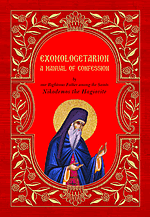
An Excerpt from Exomologetarion (A Manual of Confession)
by St. Nikodemos the Hagiorite
Canon 69 of the Holy Apostles designates that any hierarch or priest or deacon or subdeacon or reader or chanter who does not fast during Great Lent and Wednesday and Friday is to be deposed. If a layperson does not fast during these times (unless he cannot fast on account of bodily illness), he is to be excommunicated. Do you see how the Apostles numbered the Wednesday and Friday fast together with the fast of Great Lent? Therefore, just as the fast of Great Lent consists in the eating of dry foods, namely, to eat but once a day, at the ninth hour, without consuming oil or wine, likewise, the fast of Wednesday and Friday is to be conducted in the exact same manner. St. Epiphanios also says: "We fast on Wednesday and Friday until the ninth hour."[16] Likewise, Philostorgios says that the fast of Wednesday and Friday does not consist in the abstention from meat, but it designates that one is not to eat any food until the evening.[17] St. Benedict (Canon 41) also designates that the fast of Wednesday and Friday is until the ninth hour. And Balsamon forbids the consumption of shellfish on Wednesday and Friday just as during Great Lent. Let us therefore stop insensibly thinking that the fast of Wednesday and Friday is not an Apostolic directive, for behold, the Apostles in their Canons number this fast together with that of Great Lent, and in the Apostolic Constitutions they number it together with the fast of Holy Week, saying:
"One must fast during Holy Week and Wednesday and Friday."[18] But why should I say that this regulation is only of the Apostles? It is a regulation of Christ Himself, for this is what the Apostles say in Book V, ch. 14 of the Constitutions:
"He (that is, Christ) commanded us to fast on Wednesday and Friday."[19] We therefore fast on these days according to the Holy Hieromartyr Peter (Canon 15): "On Wednesday because on this day the council of the Jews was gathered to betray our Lord; on Friday because on this day He suffered death for our salvation." The divine Jerome says the same thing.
Therefore, because the fast of Great Lent is equal to the fast of Wednesday and Friday it follows that, for those who are sick or weak, the relaxation of the fast is also to be equal during these fasts. For this reason, as Canons 8 and 10 of Timothy allow a woman who is pregnant during the Great Fast to consume as much wine and food as is necessary for her condition, this also applies to the fast of Wednesday and Friday. The same holds for those who have become weak from excessive sickness, that is, they are allowed to consume oil and wine during these fasting periods. So says the divine Jerome: "The fast of Wednesday and Friday is not to be broken unless there is great necessity." The divine Augustine says the same.[20]
But because those who are lovers of the flesh desire to eat and break the fasts of Great Lent, Wednesday, and Friday, or pretend that they are sick (without actually being so), or if they are indeed sick they say that oil and wine are not sufficient to carry them through their illness, because of these pretenses, a Spiritual Father or hierarch should not believe only the words of those claiming these things, but should ask an experienced and God-fearing physician about their condition, and according to his recommendation, allow the sick to break the fast.
We must also note the following, that just as there must be a fast from food on Wednesday, Friday, and Great Lent, there must also be a fast from pleasures of the flesh. For this reason weddings cannot take place on these days, because the divine Paul commands that married couples are not to come together during a time of prayer and fasting: "Defraud ye not one the other, except it be with consent for a time, that ye may give yourselves to fasting and prayer" (1 Cor. 7:5). And the divine Chrysostom, bringing the saying of Joel as a witness: "Sanctify a fast—let the bridegroom go forth of his chamber, and the bride out of her closet" (Jl. 2:15-16), says that even newlyweds, who have strong desire, vigorous youthfulness, and unfettered urges, are not to come together during a period of fasting and prayer.[21] How much, then, are other married couples, who do not have such impulsiveness of the flesh, not to come together? Therefore, Balsamon says that married couples who do not exercise self-control during the Great Fast are not to commune on Pascha and are also to be penanced.[22] Likewise, married couples who come together on Wednesday and Friday must be corrected through penances.
Concerning the fast of Monday, even though designated in the Rubrics for monastics, many people in the world however, and especially women, observe this fast. Worthy of mention and trustworthy is the saying which some wise men put forward concerning fasting on Monday: "Our Lord commands that if our righteousness does not exceed that of the Scribes and the Pharisees (cf. Mt. 5:20), we will not be able to enter the kingdom of heaven. And because the Pharisees fasted two days of the week, as the Pharisee said: 'I fast twice in the week' (Lk. 18:12), we Christians, then, are obligated to fast three days of the week, in order for our righteousness to exceed the righteousness of the Pharisees." That the Pharisees fasted on Wednesday and Friday is clearly stated by the divine Chrysostom, explaining the words of the Pharisee: "Twice in the week."[23] Although Theophylact when explaining the Gospel passage about the Publican and the Pharisee says, along with others, that the Pharisees fasted on Monday and Thursday, not on account of some commandment, but according to tradition, believing that Moses ascended the mountain on Thursday and descended on Monday. St. Meletios the Confessor says that we should fast on Monday in order to always begin the week with fasting.[24]
Endnotes
Note: Numbering does not match the book.
[16] Expositio Fide 22, PG 42, 825B.
[17] Ecclesiasticae Historiae 10, 12, PG 65, 592C.
[18] Cf. Apostolic Constitutions, Book V, ch. 20; SC 329, p. 284.
[19] SC 329, p. 258.
[20] Note however that the divine Apostles in Book V, ch. 20, of the Constitutions also command the following: "We order you to fast on every Wednesday and Friday, and out of the surplus of your fast to give to the poor" (SC 329, p. 284). The same is said by Ignatios the Godbearer in his Epistle, To the Philippians (ch. 13), namely, that those who fast on Wednesday and Friday are at the same time to distribute alms out of their abundance to the poor (PG 5, 937A).
[21] De Virginitate 30, PG 48, 554.
[22] Responsa ad Interrogationes Marci, Question 50, PG 138, 997B-997C.
[23] In Publicanum et Pharisaeum, PG 62, 727.
[24] Alphabetalphabetos, Degree 35.
From Exomologetarion (A Manual of Confession), by St. Nikodemos the Hagiorite (Thessaloniki, Greece: 2006, Uncut Mountain Press). Order today from Uncut Mountain Supply! Posted on 10 March, 2006 (n.s.).