

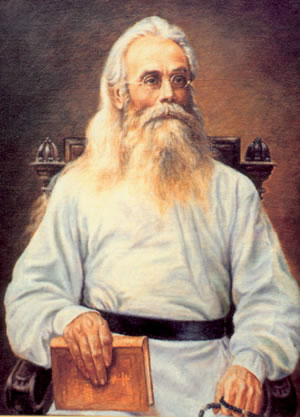
Elder Barsanuphius of Optina
Talks with Spiritual Children (Part II)
April 13, 1911
The Feast of Pascha.
“Our life is in Heaven”—this is the usual theme of my talks. By this thought I tear myself and my listeners away from attachments to earthly, created things. “Our life is in Heaven.” Dissatisfaction with things earthly can be sensed in our great worldly writers—for example, in Turgenev and Pushkin; and in foreigners—Schiller, Shakespeare and Heine.
Fifty years ago, when I was still walking along the broad streets of this world, I read Heine, but he always made a painful impression on me. This was a great talent, but it was not enlightened by the spirit of faith in Christ. He was born a Jew, and although he accepted Christianity, it was only for the sake of privilege. In his soul he was an atheist, and believed neither in Christianity nor in Judaism. The ancient pagan philosophers—Aristotle, Plato and Socrates—were not satisfied by the earth. But here was a sad phenomenon: the higher they strove to soar up from the earth, the deeper they fell.
This doesn’t happen with a Christian. On the contrary; raising himself up from the earth, tearing himself away from life’s attachments, ascending the mountain towards God, he is changed; he is reborn and becomes capable of feeling lofty joys.
Melancholy over lost blessedness shows through in the works of the great writers and artists. But nowhere is this sorrow—which is dissolved, however, by consolation—expressed so powerfully as in our church hymns and prayers. In them is heard, first a lament over lost paradise, then deep grief over sins, then a joyful and victory-bearing song about our Redeemer.
Take our Paschal Canon! How majestic and delightful it is; how it moves and comforts a soul that has not yet lost the taste for things spiritual: Now all things are filled with light, Heaven and earth and the nether regions.... Let the whole world, visible and invisible, keep festival. Yes, these are great days. In the world too they’re rejoicing on these days, but not in a spiritual way. One rejoices that he’s received money; another, that he’s received ranks and medals; another for other reasons. Some people rejoice that the Fast is over and the time has come when all food is permitted. This perhaps is a legitimate joy, if only one doesn’t believe that the chief happiness is in food.
But in the holy monasteries there is joy over the Risen Lord. Don’t cease visiting the holy monasteries, especially on feast days, even when I’m gone. Here there flickers spiritual life, which warms the soul of a man. True, there are also earthly joys which ennoble the soul. It’s not a sin to take delight in the beautiful things of this world. There are on the earth extraordinarily beautiful places: the wonderful Alps, illumined by the sun, and many magnificent spots in Italy—for example, a proverb has been made up about Naples: “See Naples and die.” Neither about Paris nor about Rome is this said, but only about Naples, which really is wonderfully nice with its azure sea and mountains.
Our northern nature is also nice. Turgenev clearly and vividly described it in his works. He, by the way, visited Optina, and was enchanted by the beauty of our Monastery. But the present world is only a weak similitude of the former pre-Fall world. There is a world on high, about whose beauty we have no comprehension. Only holy people understand and take delight in it. This world has remained undamaged, but the earthly world changed sharply after the fall into sin. This is the same as if someone divided the best work of music into separate tones. Then the impression of the whole would not be obtained. Or, for instance, one could tear a painting by Raphael into shreds and examine the separate pieces. What would we see? Well, some kind of finger; on another scrap a piece of clothing, and so on. But the magnificent impression which comes from the works of Raphael, we would of course not receive. Thus it is with the present world. Certain ascetics have even averted their gaze from it. There is known one ascetic who blocked the only window in his cell with an icon, though an enchanting view opened up from it. He was asked, “How is it that you, father, don’t even want to look, while we never tire of looking at the sky, the mountains, and the Aegean Sea with its islands.” “Why I close the window,” replied the ascetic, “is not given to you to understand, but I have no desire to contemplate the beauty of this world.” This was because the ascetic was contemplating the beauty of the heavenly world, and did not want to distract his attention from it.
Truly, he who has known the highest bliss is not sensitive to earthly consolations. But for this knowledge one must have a lofty soul.
I’m reminded of the following instance. In one rich family there was an evening party. At it, one talented girl played the best works of Mozart surprisingly well. Everyone was captivated. But by the lintel the butler who served the guests stood and yawned. “What are these gentlemen listening to such boring music for? ... Now if only they would play the balalaika!...” He was correct in his judgment, since serious music was absolutely incomprehensible to him. To comprehend even works of earthly art, one must have artistic taste. Let’s take singing. Now theatrical tunes and melodies have even penetrated into the Church, forcing out ancient chant. Meanwhile, the latter is more highly artistic, but they don’t understand this.
Once I was in one monastery at the Liturgy, and there I heard for the first time so-called “stolbovoy'chant. The Cherubic Hymn and “A Mercy of Peace...” made a powerful impression on me. There were few people there, and I stood alone in a corner and cried like a child. After the Liturgy I dropped in to see the abbot and questioned him about my impressions.
“And you, in all likelihood, have never heard stolbovoy chant?” the abbot asked me.
“No,” I replied, “I’ve never even heard the name.”
“And what is a stolbovoy nobleman?”
“Well, this means someone who is of an ancient lineage.”
“That’s how it is with stolbovoy chant—it’s an ancient chant. We adopted it from our fathers, and they from the Greeks.”
Now stolbovoy chant can rarely be heard anywhere; it’s being forgotten. Many new melodies are appearing—those of Alyabyev, Lvov, and others. True, even from among the new ones there are unusually talented ones, such as Turchaninov. His melodies are known not only in Russia, but abroad as well, even in America. The English also appreciate him. Not long ago the choir director asked me:
“Bless me to sing ‘It is the day of Resurrection...’ for the post-Communion hymn.”
“God bless you,” I replied, “that’s just what’s needed.”
“Only with a new melody.”
“What kind? Sing it through, at least in one voice.” He sang it. “Well,” I said, “that kind of melody can evoke only tears of despair, rather than a joyful state. No, sing it the ancient way.” And that’s how they sang it.
The Paschal Canon was composed by John Damascene—and so wondrously, majestically composed. It elevates the soul and fills it with spiritual joy, to the measure of the receptivity of each. But the question arises: where is the key to the opening up of spiritual joys? To this there is one answer: in the Jesus Prayer. There is great power in this prayer. It has varying degrees. The very first is the simple utterance of the words, “Lord Jesus Christ, Son of God, have mercy on me, a sinner.” At the highest degrees it attains such power that it can move mountains. Of course, not everyone can attain to this, but to utter this great prayer is not difficult for anyone, and the benefit is enormous. This is the most powerful weapon for the struggle against the passions. One woman, for instance, is proud. Another is overcome by lustful thoughts; it would appear that she doesn’t even see a man, but a thought keeps telling her to fornicate. A third is envious and has no strength to fight against it—where does one get this strength? Solely in the Jesus Prayer. The enemy distracts us from it in every way: “Well, what is this nonsense of repeating the same thing when neither the mind nor the heart takes part in the prayer? Better to replace it with something else....” Don’t listen to him, he’s lying; continue laboring in the prayer, and it will not leave you fruitless.
All the saints held to this prayer, and it became so dear to them that they wouldn’t have agreed to exchange it for anything. When their mind was distracted by something else, they suffered and strove to begin the prayer again. Their striving was similar to the desire of a thirsty man to drink. Sometimes a man does not manage to satisfy his desire due to the lack of water; then, finding a spring, he drinks insatiably. Thus did the saints thirst to begin the prayer, and they began it with ardent love.
In Zadonsk there labored the ascetic George, who was well-known in his time. Early on he realized all the vanity of worldly life and went to a monastery, but was not satisfied even with this and chose for himself absolute solitude—reclusion. Here he spent his time in fasting, prayer and contemplation of God, but temptations did not leave him. When he was still in the world, he had loved a girl with a pure love, and her image often stood before him, disturbing his state of spiritual calm. Once, sensing his helplessness in the struggle, he cried out: “O Lord, if this is my cross, give me the strength to bear it; but if it is not, then erase the very recollection of her from my memory.” The Lord heard him. And on that very night he saw in a dream a young maiden of uncommon beauty, clothed in gold raiment. In her gaze there radiated such unearthly majesty and angelic purity that George was unable to tear his eyes away from her, and with reverence he asked, “Who are you? What is your name?” “My name is chastity,” she replied, and the vision came to an end. Coming to himself, the ascetic offered up thanks to the Lord for bringing him to reason. The image he had seen in his dream was so ingrained in his mind that it completely erased all other images.
And I earnestly beg you—banish all images from your head and heart, that there might be only one image there—Christ’s. But how do you attain this? Again, by the Jesus Prayer. The other day one of our skete schema-monks came to see me.
“I’ve fallen into despondency, Abba, since I don’t see in myself—in one who bears the exalted angelic habit—a change for the better. The Lord calls one strictly to account if he’s a monk or schema-monk only according to his clothing. But how can I change? How can I die to sin? I sense my total feebleness.”
“Yes,” I replied, “we’re absolutely bankrupt, and if the Lord judges according to works, He will find nothing good in us.”
“But is there hope for salvation then?”
“Of course there is. Always say the Jesus Prayer, and leave everything to the will of God.”
“But what kind of benefit can there be from this prayer if neither the mind nor the heart participates in it?”
“Enormous benefit. Of course, this prayer has many subdivisions, from simple utterance to creative prayer. But for us, even if we were to be on the bottom step, it would be salvific. The powers of the enemy run from one who utters this prayer, and sooner or later he’ll be saved all the same.”
“I’ve been resurrected!” the schema-monk exclaimed. “I won’t be despondent anymore.”
And so I repeat: say the prayer, even if only with your lips, and the Lord will never abandon you. The utterance of this prayer doesn’t require the study of any kind of sciences. Count Leo Tolstoy was a man of well-rounded education, but he didn’t have Christ in his soul—and he perished. Earthly knowledge didn’t help him. He rejected the Holy Church—and was rejected.
Now is a joyous time—Pascha. Christ is risen from the dead, trampling down death by death, and on those in the tombs bestowing life. Who are “those in the tombs?” They are those sinful people who before were dead to God, but have been resurrected into new life through the death of Christ the Savior.
June 11, 1911
[The Elder began his talk with the reading of an excerpt from the book In the Mountains of the Caucasus, about the Jesus Prayer. He said beforehand that to those of us who had been with him earlier, that which he read would not say anything new. Everything would be familiar, but one could repeat this familiar material many times. The excerpt began with these words: “What angelic language can worthily express all the meaning of the Jesus Prayer?”]
And so the author thinks that it’s not for human language to speak of it. But what actually is an angelic language? And is there such a language? Of course there is, only we’re unable to imagine its characteristics; it’s not composed of sounds—after all, there is nothing physical there. We know that people often understand one another without words. There is a language of the eyes—people glance at one another and understand one another. There is a language of gestures, by which one may make oneself understood to deaf-mutes. What the angelic language is like, we don’t know. And only by this is it possible to express the miraculous meaning of the Jesus Prayer. It can be understood only by those who have become acquainted with it through experience. To apply himself to this prayer the author withdrew to the mountains of the Caucasus and there led a solitary life, only rarely coming to a monastery for Confession and Communion of the Holy Mysteries. Everything written in his book is worthy of complete confidence, as something realized through experience. The action of this prayer is always hidden by the greatest mysteries. It does not consist merely in speaking the words, “Lord Jesus Christ, Son of God, have mercy on me, a sinner,” but reaches the heart and mysteriously settles there. Through this prayer we enter into relationship with the Lord Jesus Christ. We become accustomed to Him, we merge with Him into one whole. This prayer fills the soul with calm and joy amidst the most difficult trials, in the midst of every oppression and human vanity.
I received a letter: “Batiushka, I’m suffocating! Afflictions are pressing in from all sides, there’s no way to breathe, nothing to look back to; I see no joy in life, I’ve lost the very meaning of it.” What do you say to such an afflicted soul? That he needs to endure? But afflictions, like a millstone, oppress a man’s soul, and he suffocates under their weight.
Take note that I’m not speaking now of unbelievers and atheists, nor of those who are depressed that they have lost God. No, it happens that believers who have set forth on the path of salvation, souls who are under the influence of Divine grace, lose the meaning of life. They don’t know that this is a temporary condition which passes, which one must wait out. They write: “I’ve fallen into despair, something dark has surrounded me.” I’m not saying that such an affliction is legitimate, but I am saying that it is the lot of every man. This is not a punishment, this is a cross; and one must bear this cross. But how does one bear it? Where is the support? Some seek this support and consolation from people—they think to find peace in the midst of the world, and they don’t find it. Why? Because one must not seek it there. One must seek peace and light and strength in God through the Jesus Prayer. When it becomes very hard for you and gloom surrounds you, stand before the icon, light the lampada if it hasn’t been lit, kneel if you’re able, or else just say “Lord Jesus Christ, Son of God, have mercy on me, a sinner.” Say it once, again, a third time—say it so that it’s not just your lips that are pronouncing it, but in such a way that it reaches your heart. And then, the sweetest Name of the Lord will without fail reach your heart, and little by little the melancholy and grief will subside and your soul will become bright. A quiet joy will reign in it.
Only those who have come to know it experientially can comprehend this wondrous action of the Jesus Prayer. Some man has never tried honey in his life and begins to ask, “What is it?” How do you explain it to him? You tell him, “It’s sweet, it’s made by bees, you get it from a hive, you slice the honeycomb into pieces....” But he still won’t understand what it is. Isn’t it simpler to say, “Do you want to know about honey? Well, try it!”... Has he tried it? Is it sweet? “It’s sweet.” “Now do you know what honey is?” “Now I know.” Was it necessary to come running for some kind of scientific explanation? No. The man tried it and understood it himself. That’s the way it is with the Jesus Prayer. Many, having come to know its sweetness and meaning, have left all, have given their whole life over to it, to come close to it, to merge with the sweetest Name of the Lord Jesus Christ.
For you in your educational or other occupations it’s impossible to fill your whole life with the Jesus Prayer, but each of you can go through, some twenty, some forty, some fifty, some even a hundred prayers a day. Each, according to his strength, can acquire the habit of it. Let one succeed in an inch, another in a yard, another in a fathom, and another, perhaps, will go forward a mile. It’s important to go, if only an inch, but go—and glory be to God! For everything, glory be to God.
People go to monasteries to take up this prayer. True, at the present time monasteries, especially convents, are placed in such a position that people are always going off to fulfill obediences, to their chores and work. It’s hard for the nuns, but all the same they’re gradually permeated by the prayer and become accustomed to it.
I remember how, when I was entering the monastery, I imagined that the only thing they knew was this (the Elder lifted up his hands prayerfully). Well, but when I did enter, it turned out quite differently. There was little prayer, few prayerful labors. You didn’t live on prayer alone—the labor of obedience was also necessary. If prayerful labor and the fulfilling of obediences took turns, replaced one another, then it was good. By this path one could easily attain salvation.
I recall that it was forty, or else fifty years ago, and I was in someone’s home. There were many guests there. Some, as is customary in the world, were playing cards; others were conversing, and then the dances began.... This wasn’t a real ball, but then, everything turned out unexpectedly. At that evening party there was one young woman of exceptional beauty. Several prospective partners approached to invite her to dance, but she refused. Then she arose, went up to the piano and began to play. One could sense that she had completely escaped her surroundings and had become absorbed within, in her own inner world and, perhaps, in these sounds. It was a wonderful moonlit night. The young woman played for a long time, and when she had finished playing she stood up, walked over to the window and became lost in thought. She began to interest me, and I attempted to make her acquaintance. I approached one lady and asked, “Do you know so-and-so?”
“I know her.”
“Introduce me to her.”
“Very well, I can introduce you, but will it be worthwhile? I assure you that she’s quite uninteresting, and you’ll find nothing in her.”
“Well, let me judge for myself.”
And I was introduced to this young woman. She was, I don’t recall exactly, but no less than twenty years old. She turned out to be very profound by nature, and lived her inward life. She had loved, and had loved as such people are capable of loving.
“It was my first and, I assure you, my last love,” she said to me, and she was not lying. “You understand, he’s all that I live by, the light of my life; everything around me and in me is filled with him. Without him all is gloom, all is darkness, and life has lost all meaning. I gave him my whole self, my soul and my heart.”
“But where is he?”
“It’s frightful to say!”
“What, has he gone far away?”
“No, he died!”
“And you love a dead man?”
“Yes, I love him, and I’ll never love another. I gave him my soul, my love—it’s all with him, he’s carried it all to the grave, and I have nothing left.”
My acquaintance with this girl did not continue for long—she soon left for Samara; but the entire time I knew her, she mourned over her first love: “I’ll never love another.” If I were to meet this girl now, I’d know what to tell her. I’d say to her, “You were in love? From such love there remains only sadness, only emptiness? And you say that you’ll never love another? But I advise you to love another—do you know Whom? The Lord Jesus Christ! You’ve given your heart to a man, and you’re perishing from melancholy. Give it to Christ, and He will fill it with light and joy in place of the gloom and sorrow that you’re left with after love for a man.”
That’s what I say to you—some, perhaps have experienced such a feeling and, half-extinguished, it still smolders as a barely visible spark in your heart. Extinguish that spark! Others, perhaps, are now going through the very height of this feeling—drive it away, don’t give your heart over to it. The Lord demands your heart for Himself: My son, give me thine heart (Prov. 23:26). Don’t allow your heart to become attached to the corruptible good things of this world—drive every passion from it. The Lord can make a habitation for Himself only in a heart free from passions.
The foundation of the whole law of God is love for God and one’s neighbor. Try to love the Lord. But how can this be attained? He Himself spoke to us about this: He that hath my commandments, and keepeth them, he it is that loveth me (John 14:21). And so, according to the word of the Lord Himself, the path to Him, to His Divine love, is a single one—the fulfillment of His commandments, concerning which He says, “My commandments are not grievous” (cf. I John 5:3). His commandments are known to all—they are read or sung each day at the Divine Liturgy: Blessed are the meek, ... Blessed are the merciful (Matt. 5:5, 7). Someone will say, “I’m unable to observe this commandment, since I have no means to give alms.” No, anyone can fulfill the commandment concerning mercy—if not materially, then spiritually. You ask, “How is that?” Here’s how: someone has grieved you in some way or another—forgive him! And that will be spiritual alms. “No, I can’t do that! Is it really possible to forgive such a terrible insult? As soon as I think of him, I’m ready to tear that person to pieces, and you say ‘forgive.’”
“So you can’t forgive?”
“I can’t.”
“But you’ve got to forgive!”
“It’s beyond my strength!”
“Not enough strength? Ask God! Turn to Him and say, Lord Jesus Christ, Son of God, have mercy on me, a sinner and help me to forgive! Say it once, again, a third time, and you yourself will learn by experience—you’ll forgive the offender.”
Now someone else says, “Here so-and-so has spread my name around ‘as evil before men’ and has slandered me in something which never happened, and with her caustic remarks and taunts she gives me no peace.”
“But you be silent, answer nothing, and endure.”
“But is it really possible to endure all this?”
“You can’t? Again, turn to the Lord: Lord Jesus Christ, Son of God, have mercy on me, a sinner, and help me to endure.” Try saying that, and you’ll see from experience what will come of it. And so, in every difficult situation, turn to the Lord, and He will help you. Fulfill His commandments and ask His help. There’s trouble if someone hopes in his own strength and takes it into his own head to fulfill them himself, without running to Divine help; if someone gets the notion to do it without humility. Two virtues are necessary in the work of salvation—one is love, and the other is humility. Without these two, not only mental prayer, but salvation itself is impossible.
After all, look at Tolstoy—how terribly he ended. But you know, earlier on he was a religious man—he ordered the serving of Molebens, he prayed with tears. Everything seemed to be in place. One thing was not there—humility. He liked to judge others and didn’t know how to forgive the shortcomings of others. Someone began to speak to him about one of his neighbors. “What do you mean,” he said, “can he really be a human being?”
“What else? Of course he’s a human being!”
“Now look—what kind of human being can he be? He’s just a creature.”
“But after all, everything is a creature; even angels are creatures: In thee rejoiceth, O thou who art full of grace, all creation: the angelic assembly and the race of man....”
“No, it’s impossible to consider him a man!”
“But why?”
“He’s an atheist, he doesn’t go to church, he doesn’t believe in God—is that a man, then?”
But his old nanny said to him... [At this point there was a knock at the door—Br. Gregory said that Br. Philip had come to ask a blessing to go riding and was asking if he could be given a horse. “They can give him a horse, let him go and harness it,” said the Elder. Br. Gregory left.]
See, that’s how it goes in the Monastery with us—the Jesus Prayer, and suddenly Philip has come, and a horse has come.... Well, the horse has come and gone and we’re left where we were.
And so, the old nanny said to Tolstoy, “Levushka, don’t judge them; just let them do as they please, but don’t you judge them—what is it to you? Look after yourself.” But he couldn’t change himself and came to a bad end.
And now another woman thinks, “I go to church, but she over there doesn’t; who does she think she is?... And look what she does do—well, you know what that resembles.” And so she continues to give her up as hopeless and considers herself to be better than others. You look, and she’s reached the point where she’s fallen lower than those whom she’s condemned. You have to consider yourself the least worthy of all.
And so, here’s the first and only path to salvation—the fulfillment of the Lord’s commandments. The Lord said concerning them that they’re not grievous, but we can’t fulfill them by our own strength. We must ask the Lord for help, and He will give it. It seems simple. Simple, but complicated as well. Let us pray to Him, that He strengthen us in His love. Amen.
From Elder Barsanuphius of Optina (Platina, CA: St. Herman Press), pp. 450-463. Copyright 2000 by the St. Herman of Alaska Brotherhood, Platina, California. Used with permission.